120+
Hours Live Lectures
20+
World Class Faculty
300+
Hiring Partners
90+
Participant Countries
Where EPAT Can Take You
I trade mostly with charts
Active trader
Turn your trading rules into code, test them on years of data, and run them automatically with risk limits.
I'm starting or switching careers
Career builder
Build the skills and project work that quant trader, researcher and developer roles look for.
I code, but I'm new to markets
Tech professional
Apply your coding to markets: how prices form, why backtests mislead, and how to research a strategy.
I lead a team or plan to set up a fund
Business leader
Understand what it takes to set up and run a quant desk: infrastructure, regulation, costs and risk.
I already run algos
Practising quant
Add rigour to what you run: trading costs, overfitting checks, portfolio risk and machine learning.
EPAT Walkthrough Video

Everything you need to know about EPAT
Programme Objectives
Curriculum: Module, Lectures, Exams
Journey: What’s Coming in the Next 6 Months?
Faculty, Ongoing Support, and Placement Aid
Demo of the EPAT learning platform
Strategies You'll Learn to Build
Momentum and Trend Following
Follow prices that keep moving in one direction.
Mean Reversion and Pairs Trading
Trade prices that stretch too far and come back.
Time-Series Strategies
Use the pattern in past prices to forecast the next move.
Factor Strategies
Choose stocks by traits you can measure.
Futures and Spreads
Trade the shape of the futures curve.
Arbitrage
Look for small price gaps between linked assets, and learn the costs and risks that often erase them.
Options and Volatility
Trade how far the market moves, whichever way it goes.
Machine Learning and AI
Let a model look for patterns, then check that they hold.
Portfolio and Execution
Combine strategies, and see how execution costs change their results.
EPAT teaches you how to build and test strategies. It doesn't hand you a ready-made strategy or a program that makes money.
Your Learning Path

Detailed Curriculum
Before you start
PPrimersStart strong, whatever your background
Some of you know markets but have never written code. Some write code all day and have never placed a trade. These seven self-paced courses get everyone to the same starting point before the live lectures begin. Two optional live preparatory sessions, on statistics and Python, run before orientation.
Financial Markets Essentials:
- Financial Markets and Instruments
- Primary and Secondary Markets
- Brokers, Exchanges and Regulators
- Indices and Market Participants
- Market Types and Terminology
Macroeconomics Essentials:
- Demand and Supply
- GDP and Economic Growth
- Inflation and Unemployment
- Financial and Monetary Systems
- Open Economy Macroeconomics
Excel Essentials:
- Introduction to Excel
- Data Formatting
- Charts in Excel
- Excel Functions
Statistics Essentials:
- Descriptive Statistics
- Probability Distributions
- Inferential Statistics
- Hypothesis Testing
- Covariance, Correlation and Regression
Python Essentials:
- Python Data Structures
- Importing and Plotting Data
- NumPy and pandas
- Conditional Statements and Loops
- Live Trading on Blueshift
Options Essentials:
- Calls, Puts and Payoffs
- Moneyness and Put-Call Parity
- Option Greeks Introduction
- Types of Volatility
- Spreads, Hedging and Iron Condor
Machine Learning Essentials:
- Supervised and Unsupervised Learning
- Reinforcement Learning
- Trend Prediction with Classification
- Natural Language Processing
- Data and Feature Engineering
How you learn: Quizzes in every course, notebooks and coding exercises in the Python, options and machine learning courses, and a test for each course
Phase 1: Build Your Toolkit
1Excel and Statistics for TradingSee every step of a trading idea before you write code
A surprising number of trading mistakes come from numbers nobody checked. So before any code, you build a full backtest by hand in a spreadsheet, where every step is visible. You pick up the statistics to judge the result along the way.
Backtesting in Excel:
- Moving Average Crossover
- VWAP and Rolling VWAP
- ATR Breakout
- Adjusted Close Prices
- Signals, Positions and Equity Curve
Statistics:
- Mean, Variance and Standard Deviation
- Covariance and Correlation
- Hypothesis Testing and p-value
- Linear Regression, Alpha and Beta
- Log and Simple Returns
Probability:
- Bayes’ Rule
- Probability Distributions
- Random Walk
- Monte Carlo Simulation
Portfolio Basics:
- Two-Asset Portfolio Risk
- Diversification
You build: A moving average backtest in Excel and a Monte Carlo simulation
2Python for TradingFrom no code to working with real market data
Never coded before? That’s fine. You start with the basics, and by the end you’re loading price data, charting it and writing your first strategy in Python. Plan for 8 to 12 hours of self-study a week alongside the live lectures, and a little more in the first months if coding is new to you.
Python Basics:
- Data Types and Variables
- Lists, Tuples and Dictionaries
- Conditions and Loops
- Functions and Lambda
- Jupyter Notebooks
Data Libraries:
- NumPy Arrays
- pandas Series and DataFrames
- Indexing with loc and iloc
- Missing Values
- Vectorised Conditions (np.where)
Market Data:
- OHLCV Data
- Rolling Windows
- Shift and Percentage Change
- Charts with matplotlib
You build: A price data analysis and your first trading signals in code
3Backtesting in PythonWould the idea have worked? And can you trust the answer?
Every trading idea has to get past a backtest first, and backtests are easy to get wrong. You’ll write your own backtester and meet the mistakes that make results look better than they are. One thing to remember: a backtest can reject an idea, but it can’t prove one.
Vectorised Backtesting:
- SMA and EMA Crossover
- Day-of-Week Pattern
- Look-Ahead Bias
- Train and Test Split
- Performance Tearsheets
Object-Oriented Programming:
- Classes and Objects
- Methods and Inheritance
- Object-Oriented Backtester
- Modular Programming
Event-Driven Backtesting:
- Vectorised vs Event-Driven
- Event-Based Architecture
- Streaming Tick Data
- Trade Parameter Optimisation
Quant Workflow:
- Data, Screens and Signals
- Trading Costs and Trade Log
- Trend Filter (ADX)
- Multi-Stock Portfolios
- Betting Against Beta
Market Theory:
- Efficient Markets and Random Walk
- Regression-Based Strategy
You build: A vectorised backtest, your own backtester, a multi-stock portfolio and a simplified Betting Against Beta portfolio
Phase 2: Markets and Strategies
4Market Microstructure and ExecutionWhat happens between sending an order and getting a fill
A strategy that looks good in a backtest can look much weaker once trading costs are counted. This module shows what happens after you send an order: how the order book works, how large orders get executed, and how to measure what a trade actually cost.
Order Book:
- Bid, Ask and Market Depth
- Level 1 to Level 3 Data
- Price-Time and Pro-Rata Matching
- Fill Probability and Expected Value
Order Types:
- Market, Limit and Stop
- IOC and FOK
- Iceberg, Pegged and Discretion Orders
Execution:
- Execution Strategy Design
- VWAP, TWAP and POV
- Smart Order Routing
- Trading Venues and Dark Pools
- Guerilla Algos and Spoofing
Trading Costs:
- Market Impact
- Timing Risk
- Transaction Cost Analysis
- Implementation Shortfall
- Trading Analytics and Benchmarks
Market Structure:
- Execution, Quant and HFT Algorithms
- Active and Passive Investing
- Maker-Taker Fees and Rebates
You build: Worked order book examples in Excel and a market impact model in Python
5Equity and ETF StrategiesTurn a market idea into a tested set of rules
Here you build a strategy on equity derivatives data. You’ll create signals, test them on data the strategy hasn’t seen, decide how much to trade, and judge the result the way traders do.
Equity Strategies:
- Factor Model
- Open Interest and Cost of Carry
- Delivery Volume
- Moving Average Strategy
- In-Sample and Out-of-Sample Testing
Performance and Sizing:
- Profit and Loss Analysis
- Sharpe Ratio
- Normalised Hit Ratio
- Maximum Drawdown
- Kelly Fraction and Stop Loss
- Brokerage and Slippage
ETFs:
- Creation and Redemption
- Authorised Participants
- NAV and iNAV
- ETF Arbitrage
- Mutual Funds vs ETFs
You build: A moving average strategy in Excel, tested in and out of sample, with Kelly sizing
6Futures and Momentum StrategiesTrade one of the most studied patterns in markets
Momentum shows up across futures markets: markets that have been rising often keep rising for a while. You’ll learn how futures are priced, build momentum strategies on them, and study the crashes when momentum failed.
Futures:
- Futures Pricing
- Spot and Roll Return
- Backwardation and Contango
- Continuous Contracts
Momentum:
- Time-Series Momentum
- Cross-Sectional Momentum
- Event-Driven Momentum
- Momentum Crashes
Spreads and Volatility:
- Calendar Spreads
- VIX and VX Futures
- Leveraged ETFs
- Volatility Drag
You build: Momentum strategies on futures data
7Statistical Arbitrage and Time SeriesFind prices that move together, and trade the gap between them
Some prices are tied together by economics, so when they drift apart they often come back. You’ll forecast prices with ARIMA and volatility with GARCH, then test for stationarity to find pairs and baskets that move together and trade the gap. Case studies of relationships that broke show you what to watch for.
Time Series:
- Stylised Facts of Returns
- Stationarity and ADF Test
- ACF and PACF
- AR and ARIMA Models
- AR(1) Trading Strategy
Volatility Models:
- ARCH and GARCH
- Volatility-Based Position Sizing
Mean Reversion and Pairs Trading:
- Bollinger Band Mean Reversion
- Cointegration vs Correlation
- Cointegration Test (Engle-Granger)
- Hedge Ratio
- Entry and Exit Rules
- Pair Selection
- Stop Loss and LTCM Case Study
Statistical Arbitrage:
- Principal Component Analysis
- Eigen Portfolios
- Basket Trades
- Index Arbitrage
You build: A pairs trading strategy, a PCA basket strategy, and ARIMA and GARCH models
8Options and Volatility TradingTrade how much the market moves, with a clear view of your risk
With options you can trade how far the market moves, whichever way it goes. You’ll price an option, read its risks through the Greeks, and design and hedge a volatility trade. Then you test it on real options data. Selling options can lose far more than the premium you collect, so you’ll also see how to size and limit that risk.
Trading Theory:
- Edge and Market Inefficiencies
- Risk Premia and Anomalies
- Efficient Market Hypothesis
Pricing:
- Payoff Diagrams
- Model-Independent Option Features
- Option Pricing Inputs
- Black-Scholes-Merton
- Put-Call Parity
Greeks:
- Delta and Gamma
- Theta and Vega
Volatility:
- Implied and Realised Volatility
- Variance Premium
- Smile, Skew and Term Structure
- Volatility Estimators (Parkinson)
- EWMA and GARCH Forecasts
Trading and Hedging:
- Straddles and Strangles
- Covered Calls
- Strike and Expiry Selection
- Earnings Volatility
- Delta Hedging
- Hedge Bands (Whalley-Wilmott)
Trade Evaluation:
- Pre- and Post-Trade Analysis
- Sharpe and Sortino Ratios
- Early Exercise
- Pin and Expiration Risk
Backtesting:
- Options Data Cleaning
- Event-Based Options Backtest
You build: An event-based options backtest on SPX options data, walked through and extended
Phase 3: Portfolio and Risk
9Portfolio and Risk ManagementMeasure and limit risk before you trade
A good strategy can still lose a lot of money when nobody is watching the risk. You’ll look at real cases where risk control failed, then learn to measure risk, set limits and spread capital across many positions.
Risk:
- Types of Risk
- Value at Risk
- Stress Tests
- Risk Limits and Pre-Order Controls
- Risk Control Systems
- Case Studies
Portfolio:
- Portfolio Weights and Optimisation
- Covariance Matrix
- Diversification
- Efficient Frontier
- Minimum Variance Portfolio
- Systematic and Unsystematic Risk
- Rebalancing
Performance (Self-Study):
- Strategy Performance Evaluation
- Strategy Profitability Analysis
- Portfolio Profitability Analysis
You build: A mean-variance portfolio, backtested in Python
Phase 4: Machine Learning and AI
10Machine Learning for TradingBuild machine learning models for trading and test them robustly
Machine learning finds patterns that simple rules miss. It also finds patterns that aren’t there. You’ll build models for trading and learn the tests that tell the two apart on new data.
Classical Models:
- Feature Engineering and Selection
- Logistic Regression
- Support Vector Machines
- Decision Trees and Random Forests
- K-Means Clustering
- Precision, Recall and Confusion Matrix
Deep Learning:
- Neural Networks
- Activation Functions
- Gradient Descent
- Backpropagation
Model Testing:
- Train, Validation and Test Splits
- Walk-Forward Testing
- Purging and Embargo
- Feature Importance (SHAP)
- Hyperparameter Tuning (Optuna)
- Backtesting ML Strategies
Text and Alternative Data:
- Alternative Data Sources
- Data Formats, Storage and Retrieval
- Sentiment and Topic Analysis
- Knowledge Graphs
Reinforcement Learning:
- States, Actions and Rewards
- Reward Design
- Bellman Equation
- Experience Replay
- Double Q-Network
You build: A machine learning strategy with walk-forward testing
11AI for Trading: LLMs and Agentic AIPut AI to work in your trading research
A large language model can read news, central bank statements and research far faster than a person, and AI agents can help with parts of a research workflow. These two live lectures show where they help, where they give wrong answers, and why a person still checks the output. You’ll leave with a blueprint for a research pipeline; running it needs a paid AI model account.
Large Language Models:
- Transformers and Attention
- FinBERT
- Prompt Design for Finance
- Reducing Hallucinations
- Model Risk
Research Uses:
- News Analysis
- FOMC Transcript Sentiment
Agentic AI:
- Multi-Agent Pipelines
- No-Code Workflow Tools
- Research Task Orchestration
- Latency and Production Limits
- Deployment Framework
You take away: A blueprint for a multi-agent quant research pipeline built with no-code workflow tools
Phase 5: Automate and Run a Desk
12Automated Trading and Backtesting ToolsConnect your strategy to a broker and see it place orders
Connect your code to a broker, pull live prices and send orders automatically, starting on a paper trading account, where results can look better than real trading. Live lectures use the Interactive Brokers API. On another broker? EPAT also includes a self-paced course on the Zerodha Kite Connect API and reading material on MetaTrader 5.
Interactive Brokers API:
- TWS and API Architecture
- EClient and EWrapper Classes
- Sync and Async Calls
- Historical and Live Data
- Order Placement
- Positions and Option Chains
REST and Streaming:
- REST APIs
- JSON Payloads and Headers
- WebSockets
Platforms:
- Python Tools for Algo Trading
- Blueshift Backtesting
- IBridgePy
- Backtest and Live in One Code
Running Live:
- Paper Trading Account
- Scheduling
- Error Handling
- Trading Day and Holiday Checks
Other Brokers (Self-Paced):
- Zerodha Kite Connect API (self-paced course)
- MetaTrader 5 (reading material)
You build: Broker API scripts and an optional IBridgePy strategy assignment
13Set Up an Algo Trading DeskWhat it takes to run trading as a business
Thinking of trading as a business? This module covers the technology, the rules and the costs, from a small setup up to what high-frequency trading needs. We teach HFT as technology and business. Its strategy code isn’t covered.
Trading Systems:
- LFT, MFT and HFT
- Traditional and Automated Architecture
- CEP Engine and Market Data
- Order and Risk Management Systems
- Exchange Gateway and Matching Engine
- FIX and Native Protocols
Infrastructure:
- Co-location
- Network Lines
- Hardware Choices
- Latency Reduction
- Algo Platform Choices
Business and Rules:
- Desk Setup Checklist
- Legal Entity
- Broker or Exchange Membership
- Managing Outside Capital
- Compliance and Audits
- Operational Risk Controls
- Setup Costs and Capital
- Developing and Developed Market Examples
You take away: A desk setup checklist and ten questions to plan your own desk
Finish
✓Capstone Project and EPAT ExamCapstone optionalAn optional capstone project with a mentor, then the exam and certificate
The capstone project is optional. If you take it, you pick your own topic and a mentor who works in the field guides you from idea to tested strategy. Everyone takes the EPAT Exam to earn the certificate.
Capstone Project (optional):
- Pre-Project Quiz
- Topic Selection
- Mentor Guidance
- Strategy Model
- Written Report
Exam and Certificate:
- Mid-Term Test
- Final Exam
- Proctored Centres or Remote Proctoring
- EPAT Certificate
Good to know: Past capstone topics include pairs trading, dispersion trading and machine learning strategies
Asset Classes
Most of the methods you learn are asset-class agnostic: the same research, backtesting and risk process works in any market you can get data for. Examples in class use Indian and US market data.
Equities
Stock strategies, multi-stock portfolios and portfolio optimisation
Futures
Pricing, roll, momentum and calendar spreads
Options
Pricing, Greeks, volatility trades and an options backtest
ETFs
How ETFs work, ETF arbitrage and pairs trading
Currencies (FX)
Mean reversion on a currency pair
Commodities
Crack spread and gold ETF examples
EPAT Projects
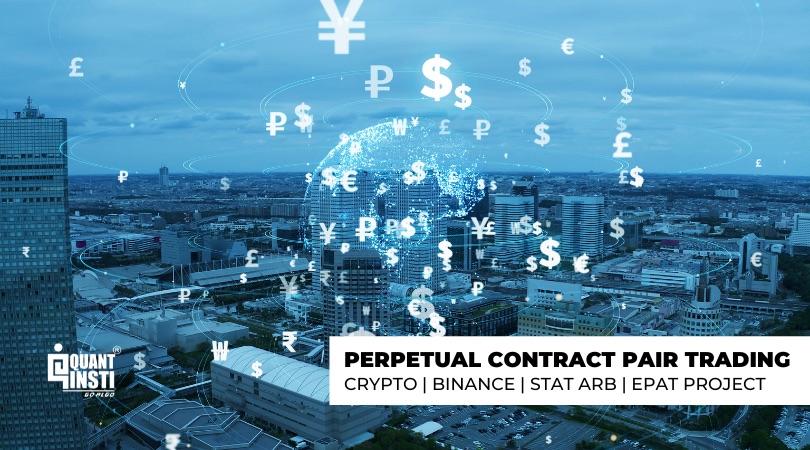
Crypto Perpetual Contract Pair Trading
Rong used Binance data to find pairs of crypto perpetual futures whose price spread tends to revert to its average, then backtested the pairs to choose trading parameters.
In the optional capstone, you pick your own topic and market, and a mentor who works in the field guides you from idea to tested strategy and a written report.
EPAT Faculty
20 practitioners and researchers teach the live lectures, from trading firms, research desks and IIM Ahmedabad.
 Dr. Robert Kissell President, Kissell Research Group Ex - UBS, JP Morgan
 Brian Christopher Founder and Researcher, Blackarbs LLC Ex - Thomson Reuters
 Dr. Thomas Starke CEO, AAAQuants Ex - VivCourt Trading, Rolls Royce
 Dr. Yves J. Hilpisch CEO, The Python Quants
 Dr. Hui Liu Founder & CEO, Creator, Running River Investment LLC & IBridgePy
 Dr. Gaurav Raizada Founder, iRage Visiting Professor, IIM Ahmedabad
 Rajib Ranjan Borah Co-Founder & CEO, iRage Visiting Faculty, IIM Ahmedabad, IIT Bombay Ex - Optiver, PwC, Bloomberg
 Anil Yadav Systematic Trading Strategies, iRage Ex - Lehman Brothers
 Ashutosh Dave Team Manager- Quantitative Research, Futures First Ex - OSTC Ltd.
 Ishan Shah Lead, Research and Content, Quantra Ex - Barclays, Bank of America Merrill Lynch
 Jay Parmar Quantitative Researcher, iRage Ex - OSTC Ltd
 Nitesh Khandelwal Chief Executive Officer and Director, QuantInsti Co-Founder, iRage Ex - ICICI Bank
 Nitin Aggarwal Co-founder, Director, Alphom Advisory Ex - Aditya Birla Group, BCG
 Prodipta Ghosh Vice President, QuantInsti Ex - Deutsche Bank, Standard Chartered Bank, DRDO, Cognizant
 Radha Krishna Pendyala Data Scientist, Refinitiv
 Varun Pothula Quantitative Analyst, QuantInsti Ex - Futures First, Accenture
 Dr. Ankur Sinha Professor, IIM Ahmedabad & Chairperson, 2-Year MBA (PGP)
 Vivek Krishnamoorthy Head - Placements | Head - Research, QuantInsti Ex- ICICI Bank, Infosys
 Manusha Rao Quantitative Researcher, QuantInsti Ex - Crisil, Cognizant
Certification
EPAT is accredited by CPD, UK (Continuing Professional Development, UK)

QuantInsti has registered this programme with GARP for Continuing Professional Development (CPD) credits. Attending this programme qualifies for 30 GARP CPD credit hours. If you are a Certified Financial Risk Manager (FRM®) or Energy Risk Professional (ERP®), please record this activity in your Credit Tracker.
Alumni Benefits
Personalised Support
Each stage of the EPAT journey is designed to help you absorb, apply, and grow with confidence. What truly sets it apart is the dedicated and personalised support that stays with you throughout. With expert guidance, and timely feedback, you're never left navigating alone.
EPAT Journey & Support Details
Alumni Benefits
EPAT alumni gain lifetime access to updated course content for continued learning. Post-completion, you can benefit from networking events, and enjoy lifetime placement services with regular job postings and upskilling opportunities.
View All Alumni BenefitsEPATian Convocation Ceremony
Trader Outcomes
QuantInsti has partnered with a global fund, with offices across Asia Pacific and the MENA region, that reviews strategies from EPATians who hold the Certificate of Excellence. It prefers US and UK markets; other global markets may be considered depending on the strategy. Only systematic strategies are considered, not discretionary ones.
Strategies are evaluated and funded at the partner's discretion. Funding isn't guaranteed.
How the funding programme worksBroker Integrations

Trading involves risk of loss. Backtested and paper-traded results don't indicate future performance.
EPAT Benefits





Learner Reviews

I am working as a Financial Analyst with leading Financial Services and wanted to add to my knowledge and skills. After all the research based on my experience, demand, and time span for learning, I…I am working as a Financial Analyst with leading Financial Services and wanted to add to my knowledge and skills. After all the research based on my experience, demand, and time span for learning, I decided to enroll for EPAT. I went through different sites and compared content, course material, and a few structures and decided to go for the EPAT course. The course is structured and presented in such a layman way that anyone without any technical knowledge can easily grasp the content and self-learn. The course actually provides hands-on experience to the Python programming language, which is helpful to understand the basics. Each and every query raised was answered quickly. I would recommend this course if you are keen on learning quantitative & Python together. I would like to appreciate and convey my BIG THANKS to the entire Quantinsti’s team.
Quantinsti has helped me during the completion of the course and post that as well. I am still using the EPAT™ videos for my references. The placement team is also helping me in finding my desired…Quantinsti has helped me during the completion of the course and post that as well. I am still using the EPAT™ videos for my references. The placement team is also helping me in finding my desired job. Great place, great faculty, a very good learning experience.
EPAT is a genuinely good course if you are interested in Algorithmic Trading. The faculty is genuinely helpful and knowledgeable with a significant amount of experience, but the best thing about…EPAT is a genuinely good course if you are interested in Algorithmic Trading. The faculty is genuinely helpful and knowledgeable with a significant amount of experience, but the best thing about E-PAT is their support, which genuinely helps you to connect with the faculty and form a proper channel of communication.The placement department is also genuinely good; they provide good opportunities, as I was able to get an internship during the course only.So, overall, it is a good course compared to the other available courses online.
Quality faculty. Great learning experience with LMS. Lifetime access to faculty and recorded lectures. Excellent pro-metric exam experience. Build yourself from a novice to an expert in algorithmic…Quality faculty. Great learning experience with LMS. Lifetime access to faculty and recorded lectures. Excellent pro-metric exam experience. Build yourself from a novice to an expert in algorithmic trading with quality support staff and hard work.
EPAT is a very well-designed program. It starts with the basics of algo trading, finance, statistics, and covers advanced statistics, machine learning. The course also focuses on programming…EPAT is a very well-designed program. It starts with the basics of algo trading, finance, statistics, and covers advanced statistics, machine learning. The course also focuses on programming languages Python and R. The coursework also focuses on periodic tests and assignments, which enable you to reinforce learning. The faculty is renowned and knowledgeable. The support staff is also very helpful. Quantinsti continuously focuses on incorporating the latest market trends as a part of this course. In all, this course lays a strong foundation for a career in algorithmic trading.
They provide great courses that combine concepts from computer science, statistics, and finance, which could help one form a firm base in algorithmic trading and then go on to work in the industry or…They provide great courses that combine concepts from computer science, statistics, and finance, which could help one form a firm base in algorithmic trading and then go on to work in the industry or maybe even set up your own firm!
EPAT is indeed a highly recommended course for anyone serious about Algo-Trading. The faculty is great with an impressive academic and professional profile. Their support team is wonderful. They…EPAT is indeed a highly recommended course for anyone serious about Algo-Trading. The faculty is great with an impressive academic and professional profile. Their support team is wonderful. They provide placement assistance, and the course is very well-crafted. It was an amazing learning experience with EPAT!
Really helpful for people willing to learn algo trading. Their placement cell is superb, and you will definitely land a good job.
The course provides an opportunity to learn from industry experts & veterans who give valuable inputs based on their own experience. Regular assignments help one to intuitively understand & retain…The course provides an opportunity to learn from industry experts & veterans who give valuable inputs based on their own experience. Regular assignments help one to intuitively understand & retain relatively complex concepts & put them to practical use. Life-long support & access to the latest content is the icing on the cake.
EPAT is the most comprehensive program covering almost all aspects of trading. Not only that, it opens up a whole new world of leveraging technology to trade in a much smarter way than others. All in…EPAT is the most comprehensive program covering almost all aspects of trading. Not only that, it opens up a whole new world of leveraging technology to trade in a much smarter way than others. All in all, if one has a tech background, this program will take that person to another paradigm.
The EPAT is a great course for individuals wanting to make a career in the field of algorithmic trading as the course contents seamlessly blend the theoretical concepts regarding trading strategies…The EPAT is a great course for individuals wanting to make a career in the field of algorithmic trading as the course contents seamlessly blend the theoretical concepts regarding trading strategies along with mathematical models and theories, using statistics and performing the same in programming languages.
The EPAT program was a very comprehensive program for an individual of any background to build a strong foundation in algorithmic and quantitative trading. It helps you build a sound mechanism to…The EPAT program was a very comprehensive program for an individual of any background to build a strong foundation in algorithmic and quantitative trading. It helps you build a sound mechanism to pursue your interests in this field with great clarity and the best guidance you can find in the industry. The program was fairly complex but very much doable with the support managers provided to each student.
Quantinsti's EPAT is truly the best platform to initiate either a career in Quant & Algo Trading or pursue it independently.It offers essential and foundational skills, such as programming and…Quantinsti's EPAT is truly the best platform to initiate either a career in Quant & Algo Trading or pursue it independently.It offers essential and foundational skills, such as programming and statistical skills, for both newbies and experienced finance professionals without a coding and maths background or training.The placement cell strives to provide the best opportunities for freshers to secure a job in the domain of Quant & Algo trading.
This is the best institute for Algorithmic Trading in India. After completing the EPAT certification, I feel much more confident in terms of Back- testing, strategy development, and Live…This is the best institute for Algorithmic Trading in India. After completing the EPAT certification, I feel much more confident in terms of Back- testing, strategy development, and Live Deployment.The institute provides a wide range of courses on their Quantra page, such as Options Trading using Machine Learning, Price action Pattern detection, Mean Reversion, etc. I have done several other courses before EPAT from other vendors, and I strongly feel that most of the other people in this industry are just trying to scam you by selling a strategy.But that's not the case with Quantinsti. I can assure you that by doing EPAT and other Quantra courses, you will definitely gain a deeper understanding of transaction costs, and over - fitting, which are the two main factors that directly affect the validity of any trading Idea.
Never thought it would be so easy for me to cover the EPAT program, even though I was not familiar with any of the computer languages before. It was very interactive, doesn’t feel like an online…Never thought it would be so easy for me to cover the EPAT program, even though I was not familiar with any of the computer languages before. It was very interactive, doesn’t feel like an online session. Concepts are covered clearly and take time to clarify doubts individually. It was very useful for me in many perspectives, provided technical skills and a good understanding in the world of quantitative finance. Even the placement cell is really impressive, with a few good mails for placements every week.
I recently had the pleasure of attending the EPAT course at QuantInsti, and I must say that it was an absolutely fantastic experience. From the moment I enrolled in the program until the completion…I recently had the pleasure of attending the EPAT course at QuantInsti, and I must say that it was an absolutely fantastic experience. From the moment I enrolled in the program until the completion of the course, I was impressed with its exceptional level of professionalism and dedication to fostering a learning environment. The instructors at QuantInsti are experts in their respective fields and possess a deep understanding of quantitative finance.Their teaching methods are clear, concise, and tailored to the needs of each participant.They effortlessly translate complex concepts into easily understandable terms, making even the most intricate topics accessible to all. One aspect that truly stood out for me was the interactive nature of the courses.The instructors actively encourage participation and discussion, creating a dynamic and engaging atmosphere.I appreciated the opportunity to collaborate with fellow learners, allowing for a rich exchange of ideas and perspectives.Furthermore, the course materials provided by QuantInsti were comprehensive and well- structured.The content was up - to - date and aligned with industry standards, ensuring that I gained relevant knowledge and skills that could be immediately applied in real - world scenarios.The practical exercises and case studies further reinforced my understanding and boosted my confidence in quantitative finance. In addition to the outstanding instruction, the support and assistance I received from the staff at QuantInsti were commendable.They were prompt in addressing any queries or concerns I had throughout the course, and their genuine commitment to my success was evident. I must also highlight the efficient online learning platform offered by QuantInsti.The platform was user - friendly, providing easy access to course materials, recordings of live sessions, and additional resources.This flexibility was invaluable, as it allowed me to learn at my own pace and revisit specific topics whenever needed. Overall, my experience with QuantInsti surpassed my expectations.I walked away with a wealth of knowledge and skills that have already proven invaluable in my professional pursuits.I wholeheartedly recommend QuantInsti to anyone looking to enhance their understanding of quantitative finance and gain a competitive edge in the industry. Thank you, QuantInsti, for the exceptional learning journey!
Quantinsti has been instrumental in my HFT research as an EPAT Alumni member and PhD candidate in finance. Their comprehensive courses and expert instructors have provided me a strong foundation in…Quantinsti has been instrumental in my HFT research as an EPAT Alumni member and PhD candidate in finance. Their comprehensive courses and expert instructors have provided me a strong foundation in the domain of algorithmic trading. The practical learning approach, industry connections, and mentorship have been invaluable, enabling me to conduct cutting-edge research in the rapidly evolving field of HFT. I highly recommend Quantinsti for anyone seeking exceptional support and knowledge in this domain.
The course was good and to the point. The content is way better than other online courses, and assistance in placement is really a plus point. So, I would really recommend this course to all trading…The course was good and to the point. The content is way better than other online courses, and assistance in placement is really a plus point. So, I would really recommend this course to all trading enthusiasts.
The EPAT course is truly worth your time and money spent. Faculty members are practicing professionals with expertise in the area. If you are looking to start your career in the quantitative field,…The EPAT course is truly worth your time and money spent. Faculty members are practicing professionals with expertise in the area. If you are looking to start your career in the quantitative field, you must explore the courses offered by Quantinsti.
This course introduced me to the professional/institutional level of trading. The placement team is very impressive. All the knowledge gained from this course helped me in managing funds, more than…This course introduced me to the professional/institutional level of trading. The placement team is very impressive. All the knowledge gained from this course helped me in managing funds, more than 5CR of funds. Thank you, QuantInsti, for changing my life.
I highly recommend QuantInsti Quantitative Pvt Ltd to anyone interested in pursuing a career in quantitative finance. Their commitment to knowledge and practical application, as well as their strong…I highly recommend QuantInsti Quantitative Pvt Ltd to anyone interested in pursuing a career in quantitative finance. Their commitment to knowledge and practical application, as well as their strong placement support, makes them a top choice in the industry.
The Placement team at Quantinsti is very helpful and supportive. The team helped me get placed in my dream role as a Quant Analyst.

Trading Specialist at TD Ameritrade InstitutionalReview on quantinsti.com
I don’t have a background in programming, so it was vital for me to find a programme that provides in-depth instruction. It’s kind of surreal to look back at my journey of progress with…I don’t have a background in programming, so it was vital for me to find a programme that provides in-depth instruction. It’s kind of surreal to look back at my journey of progress with EPAT. I went from having no idea how to write a line of code to acquire the skills needed to develop a custom backtest engine for strategy development, and finally, to build algorithms for automation. Having passed Level 3 of the CMT program, I was excited to add Quant theories and strategies, including machine learning, to my knowledge base. The expert practitioners who curate EPAT’s educational content not only provide exceptional insights but practical, real-world applications. Moreover, what I believe makes EPAT unique from any other programme is the culture and the people representing the organization. The dedicated support during the programme and even after becoming part of the alumni is outstanding. Thank you all so much for your devotion to my development. I feel deep gratitude for being part of the QuantInsti family.

Software Engineer at WindstreamReview on quantinsti.com
QuantInsti is the best place to learn professional algorithmic and quantitative trading. The EPAT programme is a highly structured and hands-on learning experience and it's being updated frequently. The faculty and staff are extremely…QuantInsti is the best place to learn professional algorithmic and quantitative trading. The EPAT programme is a highly structured and hands-on learning experience and it's being updated frequently. The faculty and staff are extremely competent and available to address any concerns you may have. Upon completion of the EPAT programme, you will have the necessary tools to begin a career in algorithmic/quantitative trading.

Managing Director at MessFreeCharts.comReview on quantinsti.com
After having completed this course, I can highly recommend it. The instruction is top notch and well-paced. The ability to review the lectures after the fact and pause and re-wind concepts was invaluable. I…After having completed this course, I can highly recommend it. The instruction is top notch and well-paced. The ability to review the lectures after the fact and pause and re-wind concepts was invaluable. I also found that the lecturers were extremely easy to understand both in terms of accents but also in terms of taking rather complicated subjects and reducing them to bite sized pieces of digestible information.

Data Scientist at GlobantReview on quantinsti.com
The accompaniment of the staff throughout the whole process at QuantInsti was outstanding. The faculty is greatly skilled. Their thoughts based on their experience was an important added value to the lectures.

Director at FLIN InternetReview on quantinsti.com
It was an intense 6 months, spending all weekend long studying algorithmic trading strategies, python and a lot of statistics. The programme covers all you need to start building up your knowledge and saves…It was an intense 6 months, spending all weekend long studying algorithmic trading strategies, python and a lot of statistics. The programme covers all you need to start building up your knowledge and saves your time showing some key points that youtube doesn´t teach you. Thank you all and my many thanks to the professors.

Discretionary TraderReview on quantinsti.com
For me, it was really important to go for a course having exceptional faculty. QuantInsti had Dr Ernest P. Chan, Dr Euan Sinclair and other world-class professors regarding algorithmic trading. And that is why…For me, it was really important to go for a course having exceptional faculty. QuantInsti had Dr Ernest P. Chan, Dr Euan Sinclair and other world-class professors regarding algorithmic trading. And that is why I knew EPAT was for me. It is really important to get exceptional-quality knowledge and to be able to apply rapidly lots of strategies to invest with. Besides, I'm thrilled to apply for various job opportunities that I have received from the Placement Team. Thanks to EPAT, I have developed some really good strategies and I'm also creating my own application to invest with interactive brokers. I'm really thankful to EPAT and Subash, my Support Manager, who was really really helpful with my course progress.

QA Automation Trader at Brooks MacdonaldReview on quantinsti.com
I decided to pursue building an additional income stream using Financial Trading. Part of the challenge was finding a means to gain the required knowledge in this area and the EPAT course has been…I decided to pursue building an additional income stream using Financial Trading. Part of the challenge was finding a means to gain the required knowledge in this area and the EPAT course has been the gateway to my journey. Although it is an online course, the lectures which accompanied each of the sections were invaluable to engage with a real person. Additionally, having a personal liaison who was there throughout the journey was an immense benefit, consistently in contact and available to support you. For anyone thinking of getting knowledge on Algorithmic Trading, I can definitely recommend EPAT, no matter where you are on your own journey.

CIO / Partner at Cloud 8 CapitalReview on quantinsti.com
The EPAT programme has really been a good experience for me: I've learned a lot about how financial markets work, how to code strategies in Excel, Python and R, got introduced to advanced statistical…The EPAT programme has really been a good experience for me: I've learned a lot about how financial markets work, how to code strategies in Excel, Python and R, got introduced to advanced statistical concepts like ARIMA and GARCH and how to apply Machine Learning algorithms into trading systems. The support team has been great in assisting my learning experience. It's also an excellent way to connect with other students and with the lecturers (that are all carefully selected and highly professional). Highly recommended!

Senior Consultant at Argen ConsultingReview on quantinsti.com
The EPAT programme provides the tools required to develop and implement algorithmic trading strategies. It covers all the required areas to implement them, right from statistics, python programming and software development to machine learning.…The EPAT programme provides the tools required to develop and implement algorithmic trading strategies. It covers all the required areas to implement them, right from statistics, python programming and software development to machine learning. Additionally, it allows us to review complex concepts and revisit all the content even after the programme finishes.

Portfolio Manager at Singalliance Pvt LtdReview on quantinsti.com
EPAT helped me to interact with a growing community of alumni from more diverse backgrounds. If you are looking for a professional overview of the space, or are already an expert looking at some…EPAT helped me to interact with a growing community of alumni from more diverse backgrounds. If you are looking for a professional overview of the space, or are already an expert looking at some new topics, EPAT can help you learn something new. I look forward to seeing continued growth in QuantInsti as well as the network of clever people coming out of the programme.
Fees and Admissions
Next batch starts 9th January, 2027.
Black Friday 10% off on EPAT fees ends 5 Dec. Applies to enrolments made before the offer closes.
Ready to apply? Start your application · Check if you qualify for financial aid
FAQs
How long is EPAT, and how much time does it take each week?
EPAT runs for six months, with two live lectures a week, usually on weekends, each about 3 hours long. Plan for 8 to 12 hours of self-study a week on top of that, and a little more in the first months if coding is new to you. If you miss a lecture, you can watch the recording.
I've never coded. How much coding will I do?
A fair amount, because you write and run the code yourself in assignments. You start from the basics in the Python Essentials and Module 2, and by the end of Module 2 you're loading price data, charting it and writing your first strategy. Optional tutorials in Module 2 give you time for questions.
I'm new to trading. Where do I start?
With the primers. Seven self-paced courses unlock when you enrol, covering financial markets, macroeconomics, Excel, statistics, Python, options and machine learning. Each has quizzes, so you can check you're ready before the live lectures begin.
How much maths do I need?
The statistics and probability you need, such as regression, hypothesis testing and distributions, are taught in the Statistics Essentials primer and Module 1. Option pricing, time series and machine learning use more maths, and you work through them with code and market data. If you're unsure, a counsellor can check your starting point.
Can I learn to automate my own strategy?
Yes. In Module 12 you connect your Python code to a broker, pull live prices and send orders automatically on a paper trading account. In the optional capstone project you can make your own strategy for the topic and work on it with a mentor. The course teaches the process.
How much machine learning and AI is covered?
Module 10 covers machine learning in depth: classical models, deep learning, reinforcement learning, and walk-forward tests that check whether a model holds up on new data. Module 11 is two live lectures on large language models and AI agents for trading research, including where they give wrong answers.
Is options trading covered?
Yes. Options are a core asset class, along with equities and futures. Module 8 covers pricing, the Greeks, volatility and hedging, and you backtest an options strategy in Python. Selling options can lose far more than the premium you collect, so you'll also learn to size and limit that risk.
Will I get ready-made strategies or a trading bot?
No. EPAT teaches you how to build, test and automate strategies, and you code most of them yourself. It doesn't hand you a ready-made strategy or a program that makes money. Strategies shown in class use historical data and are for learning, not investment advice.
Does EPAT teach technical or fundamental analysis?
EPAT is about rule-based trading, so you use indicators such as moving averages, MACD, Bollinger Bands, VWAP and ADX as rules you can backtest. Fundamental analysis isn't a module of its own. The Macroeconomics Essentials primer covers GDP, inflation and monetary systems.
Which markets does EPAT use? What about forex, gold or crypto?
Examples use Indian and US market data. Equities, futures and options are the core asset classes, and ETFs are covered too. Currencies and commodities, including gold, appear as worked examples. The methods apply to any market or asset class with reliable data.
Is market data provided?
Yes. Data for lectures and assignments comes with the course notebooks, so you can start without buying any. Intraday options data or intraday single stocks/futures data isn't supplied, so for that kind of research you'd source your own from a market data vendor.
Which programming language does EPAT use? Is C++ taught?
All live coding is in Python. In Module 1 you also build a backtest in Excel, so you can see every step before you write code. C++ isn't taught.
Which brokers and platforms are used? What about Zerodha or MetaTrader 5?
Live lectures use the Interactive Brokers API, Blueshift and IBridgePy. If you trade through another broker, EPAT also includes a self-paced course on automating trades with the Zerodha Kite Connect API, and reading material on MetaTrader 5. Module 12 teaches REST APIs and WebSockets, which many broker APIs use. Check your broker's API terms and local rules before automating real orders.
Will I trade with real money during the course?
The course doesn't ask you to put real money at risk. In Module 12 you run your strategy on a paper trading account with virtual money, and paper results can look better than real trading would. Trading real money later is your decision and your risk.
What is the EPAT Capstone Project?
It's optional. You pick your own topic, and a mentor who works in the field guides you from idea to tested strategy and a written report. Past topics include pairs trading, dispersion trading and machine learning strategies. It doesn't count towards your final score.
What certificate do I get?
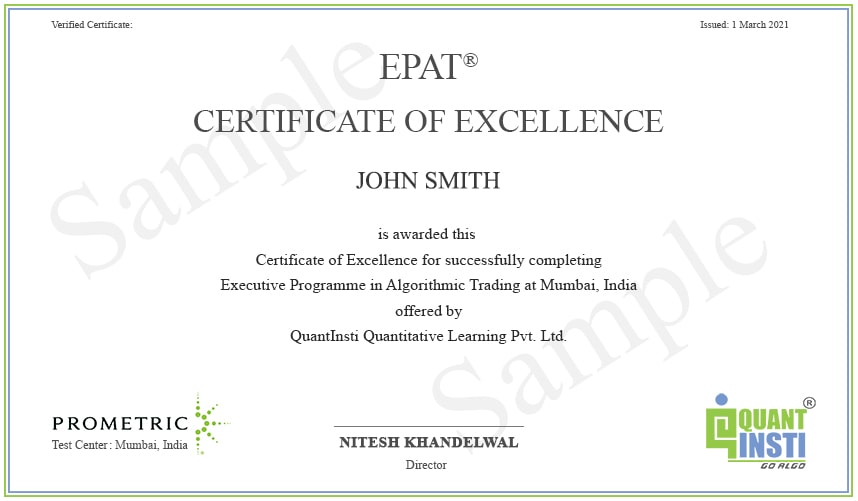
Complete the coursework and pass the EPAT exam to receive the Certificate of Excellence. Eligibility depends on attendance (live or through recordings), quizzes and assignments, the mid-term test and the final exam, which you can take at a proctored centre or remotely. EPAT is accredited by CPD UK, and the programme qualifies for 30 GARP CPD credit hours for FRM and ERP holders.
Does EPAT cover high-frequency trading or setting up a desk?
Module 13 covers running trading as a business, from a small setup up to what HFT needs: trading systems, co-location, latency, legal entity, compliance and setup costs. HFT is taught as technology and business. Its strategy code isn't covered.
What is the fee for EPAT?
- Direct Subsidy Benefits - Applicable to individuals with an annual income up to INR 2 million (Indian Rupees 20 lakhs) per annum
- Full-time academia, including full-time students & full-time professors/lecturers.
Are there any additional charges apart from the programme fees?
What financial assistance is available?
- Merit-Based Scholarship - QuantInsti offers scholarships to deserving candidates who score well on the test. You can apply for the scholarship here.
- Student Discounts -QuantInsti believes in investing in the future of tomorrow, the students of today. We have a discounted fee for full-time students.
- Participants from Emerging Economies -Special consideration is given to participants from Emerging Markets so that the programme is more affordable.
- Flexible Payment Plans – QuantInsti is partnered with financial institutes that provide education-related flexible payment plans to Indian resident participants.
- Direct Subsidy Benefits - Applicable to individuals with an annual income up to INR 2 million (Indian Rupees 20 lakhs) per annum.
- Students – Full-time academia, including full-time students & full-time professors/lecturers.
What are the Flexible Payment Plans offered for EPAT?
- First and Last Name
- Scanned Copy of PAN Card & Aadhaar Card - This will help to generate your CIBIL score
- Last three months pay slip (in case of a salaried employee) or last three year filed ITR (in case of self-employed)
- Last 4 months bank statement
What is the EPAT scholarship test?
What is the admission process for EPAT?
- Submit your application form here.
- Wait for your application to get accepted.
- Pay the fees.
Would I get a refund if I change my mind after enrolling?
While pursuing my undergraduate/bachelor’s degree, can I apply and be accepted into EPAT?
Without programming or technology background, can I apply and be accepted into EPAT?
Without trading or financial markets experience, can I apply and be accepted into EPAT?
How many batches run in a year?
What is the last date to apply for the upcoming batch?
What are the benefits offered to Indian residents?
- Direct Subsidy Benefits - Applicable to individuals with an annual income up to INR 2 million (Indian Rupees 20 lakhs) per annum
- Full-time academia, including full-time students & full-time professors/lecturers.
What if I miss a live lecture?
Every live lecture is recorded, so you can watch any session you miss, and watching the recording counts towards attendance. Once you complete EPAT, you also get lifetime access to the lecture notes and videos, including updates as the content is refreshed.
What time zone are the live lectures in? Can I attend from the US or Europe?
Live lectures run on weekends, and there are two batch timings: 10:00 am to 1:00 pm IST, or 4:00 pm to 7:00 pm IST. Pick the one that suits your time zone. If neither works, you can watch the recordings, which count towards attendance.
- Dubai: 8:30 to 11:30 am (morning batch), 2:30 to 5:30 pm (evening batch)
- Singapore: 12:30 to 3:30 pm (morning batch), 6:30 to 9:30 pm (evening batch)
- London: 4:30 to 7:30 am (morning batch), 10:30 am to 1:30 pm (evening batch)
- New York: 11:30 pm to 2:30 am the night before (morning batch), 5:30 to 8:30 am (evening batch)
Local times are for November to March. London and New York move one hour later during daylight saving time.
Can I attend classroom sessions?
Can I attend online sessions on mobile/tablet?
Does any part of the programme require physical attendance?
How will I learn practical aspects of trading online?
- The curriculum is practice-oriented and designed by practitioners to ensure you learn concepts from a real-world perspective.
- Hands-on learning is encouraged—faculty members guide you to work on your machine, interact personally and quiz you during sessions.
- Data-driven approach—almost every concept is taught using real financial market data.
- Projects & mini-projects—students work on them with faculty guidance.
- Self-practice is key—open-ended assignments help reinforce learning and are individually graded.
Will I trade in live markets during classroom sessions?
How will I interact with faculty members?
- Live interaction with faculty during lectures.
- Get your doubts resolved before or after lectures by faculty.
- Work under the mentorship of a subject matter expert during EPAT project work.
- Stay connected - you can also interact with faculty anytime through your support manager.
What kind of help/assistance is available to an EPAT participant?
- Dedicated Support Manager will guide you through the six months. Your manager will resolve your doubts and keep you motivated and engaged in this new and demanding career path.
- Expert guidance from industry practitioners who are part of the faculty.
- Career support includes resume building, career counseling, mock interviews, and more. You will also receive job postings from the very first month.
- Additional learning resources with extra links and content will be shared with you to enhance your learning.
- Alumni support is provided post EPAT, to help you grow in the algo trading domain and network with your peers.
- Lifetime access to updated lecture notes and videos is provided after completing EPAT successfully.
Which books and learning materials are available to an EPAT participant?
- Machine Learning in Trading
- Python Basics
What is the course schedule?
- Live Lectures
- Test & Assignments
- Live Project (optional)
- Final Examination
How can I write the EPAT exam?
How can I get to know about the nearest exam centre?
What happens to my certificate if I fail the exam or am unable to write the exam?
How do I register for the exam?
How will EPAT placement team help me in my job quest?
Do you guarantee a job after successful completion of the programme?
Is the career assistance offered by EPAT team available worldwide?
What kind of roles and positions are available to EPAT certified professionals?
- Developer
- Quant Analyst
- Quant Researcher
- Trader
- Strategist
As a fresher in Finance, and an expert in coding, what are my prospects in the trading industry?
Are internships also part of placement services provided by EPAT team?
How many EPAT alumni have been placed? Who are they?
What is the salary range that be expected post completion of the programme?
- Quant Trader: Up to INR 2.5 million per annum + PNL/ Performance Bonus,
- HFT Trader: Up to INR 2.5 million per annum + PNL/ Performance Bonus,
- Data Scientist: Up to INR 2 million per annum,
- Quant Research Analyst: Up to INR 2.5 million per annum,
- Quantitative Trader: Up to USD 200,000 per annum + PNL Bonus,
- Quantitative Research: Up to USD 80,000 per annum,
- Quantitative Developer: Up to USD 100,000 per annum
Which hiring companies are partnered with QuantInsti?
What does QuantInsti do?
- EPAT® (Executive Programme in Algorithmic Trading)EPAT is the world's first proctored certification in algorithmic trading. It is a fully online, 6-month instructor-led programme designed by 20 industry experts based on their 250+ years of combined experience. EPAT faculty members include Dr Thomas Starke, Dr Robert Kissell, Nitesh Khandelwal, and Rajib Ranjan Borah, among others. See the entire list of faculty members here.
- Quantra®is a self-paced, Python-focused, interactive learning platform with 50+ trading courses on Quantitative & Algorithmic Trading applicable across asset classes including Stocks, Options, Derivatives, Futures, Commodities and more. It is integrated with Blueshift to encourage traders to learn and implement seamlessly.
- Blueshift®Blueshift is an all-in-one automated trading platform that brings institutional-class infrastructure for investment research, backtesting, and algorithmic trading to everyone, anywhere and anytime. It is fast, flexible, and reliable. It is also asset-class and trading-style agnostic. Blueshift helps you turn your ideas into investment-worthy opportunities..
- Free resourcesAccess blogs, webinars, eBooks, and free courses to stay updated in the domain.
Where is QuantInsti based?
Who are the people behind it?
How is EPAT different from Quantra courses?
Quantra courses are self-paced and focused. Each one covers a single topic, such as options or machine learning, and you work through it on your own schedule with interactive Python exercises.
EPAT is a six-month live programme that covers the full path, from statistics and Python to strategies, risk, machine learning and automation. It adds live lectures with practitioner faculty, a dedicated support manager, graded assignments, a proctored exam for the Certificate of Excellence, and career support.
A Quantra course suits you if you want one skill at your own pace. EPAT suits you if you want a structured programme from start to finish, with faculty and support along the way.

