

Here's a sum worth doing before signing up for anything. Put ₹2 lakh behind a strategy that makes 12% a year before fees, pay ₹1,500 a month for the service that runs it, and 9 of those 12 percentage points go to the subscription. Put ₹25 lakh behind the same strategy and the same fee takes less than one point. So the managed-versus-build question starts with arithmetic, and only after that does it become a question of skills, time and temperament.
Convenience or control?
It comes down to convenience against control. A managed service or configurable platform gets you live quickly with little or no code, but you depend on someone else's logic, infrastructure and risk controls, and when it loses money you usually can't tell why. Building your own takes months and real skill, and in return you can see, test and change everything. Plenty of traders end up in between, writing their own strategy logic and renting the data, backtesting and execution plumbing.
What do "managed" and "build your own" really mean?
A managed service runs someone else's strategy on their infrastructure, so you choose the settings and they handle the rest. Building your own means you write the rules, the backtest and the execution, and you own every decision. Most traders sit somewhere between those two ends of the spectrum.
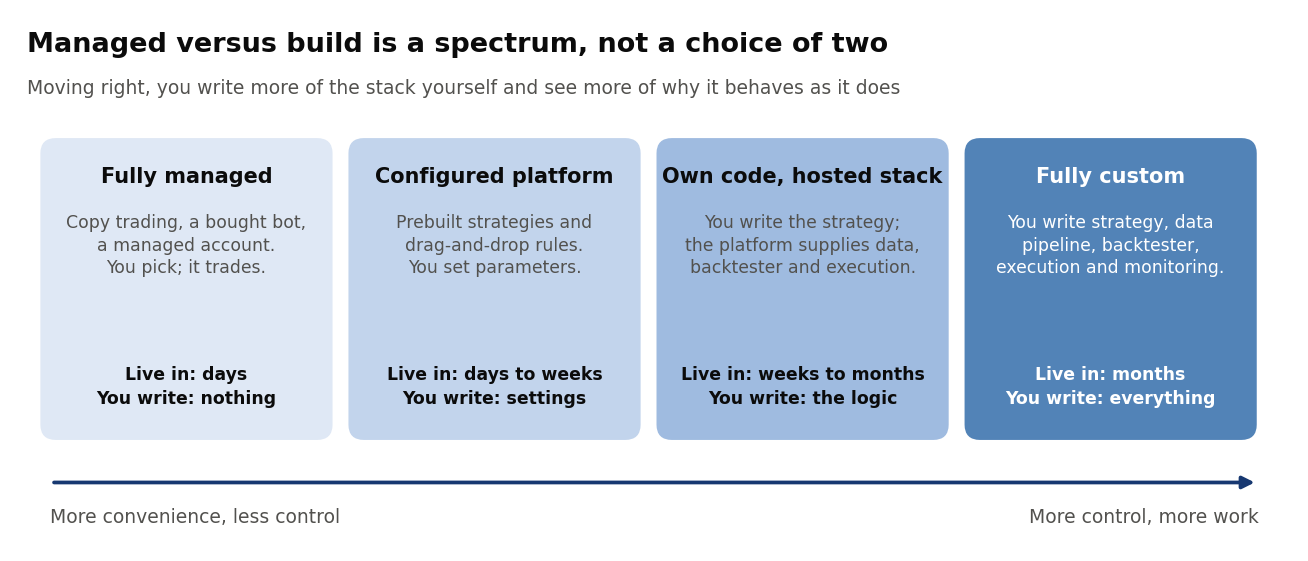
At the managed end sit copy trading, a bought bot or a managed account: you pick, it trades. Next come platforms with prebuilt strategies and rule builders, where you set parameters without writing code. Further right are hosted frameworks, where you write the strategy in Python and the platform supplies data, a backtester and broker connections. At the far end is the fully custom build, where the strategy, data pipeline, backtester, execution layer and monitoring are all your own code.
What matters is how much of the logic you can see and change, whatever the tool. A drag-and-drop platform where you've set every rule yourself gives you more understanding than a Python bot copied from a forum that you can't explain (its author may not be able to explain it either).
What's the case for a managed service?
Mostly speed. You can be live in days rather than months, without maintaining servers, handling broker logins or cleaning data. For someone who wants to find out whether systematic trading suits them at all, that's a quick way to learn.
The costs are real, though, and they're easy to underweight at the start. The biggest is that a trader can't see inside the strategy. A losing month could be the kind of market it's designed to struggle in, or a sign it has stopped working, and from the outside there's no way to tell. (Our article on pre-made trading algorithms explains why that so often ends with people quitting at the bottom.) When volatility halves or a rule changes, you also wait for the provider to adapt.
The edge is shared as well. A strategy followed by many subscribers trades the same signals at the same time, and shared or published edges tend to shrink. McLean and Pontiff (2016) found that published stock-return patterns lost about 58% of their returns once the papers were out.
Then there are fees. Subscriptions are fixed costs, and fixed costs punish small accounts, whereas performance fees take a share of profits whatever the account size.
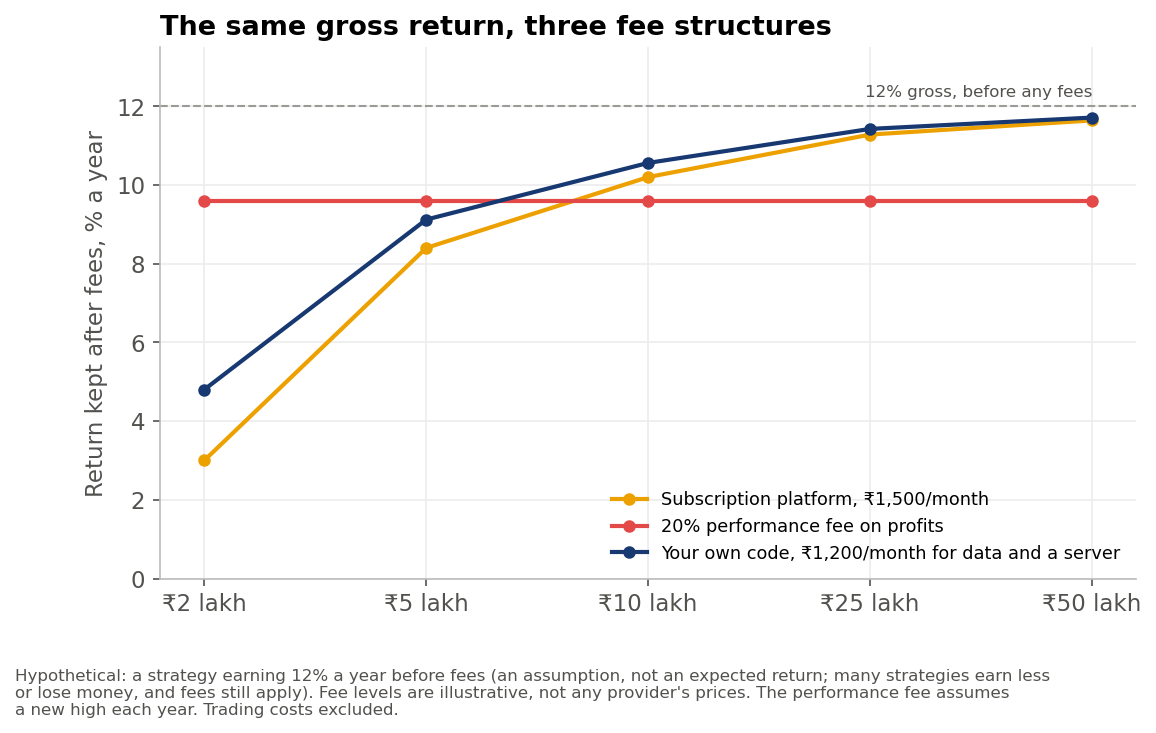
The 12% here is an assumption chosen to make the arithmetic visible, not an expected return (many strategies earn less than that or lose money, and the fees are charged regardless). On a ₹2 lakh account, the ₹1,500 subscription leaves 3 of the 12 points. On ₹25 lakh it takes less than a point. A 20% performance fee takes 2.4 points at every size, though only in a year when the strategy makes a new high.
Running your own code isn't free either. About ₹1,200 a month covers a broker's market data and a small cloud server with a static IP, at September 2026 list prices, and at ₹2 lakh that's 7.2 of the 12 points (the dark blue line). So a small account pays heavily whichever route it takes. Building wins on control, and on cost only once the account is larger. We've kept the chart deliberately simple (one gross return, three round-number fee levels, no taxes), so plug in your provider's real schedule before drawing conclusions. On small accounts, the gap between fee structures can easily be larger than the gap between strategies.
SEBI's rules give you one more check. Under its retail algo framework, providers offering algos through brokers must be empanelled with the exchanges, black-box providers must register as research analysts, and brokers may not refer to the past or expected returns of an algo. A provider advertising returns is a warning sign on its own.
What's the case for building your own?
Building gives you what a managed service can't. You know what the strategy does, you can test it however you like, and you can diagnose a drawdown because you wrote the rules. Nobody else is trading your signals, and you can change the strategy when the market changes. Small size can even help here. A strategy that can only absorb ₹20 lakh is useless to a fund, so nobody large is competing for those trades, and no vendor has a reason to sell it either.
The trade-off is effort. Building needs Python, some statistics and a backtesting habit that doesn't fool itself. It also needs the operational work of running a bot unattended, which our articles on monitoring trading bots and on deploying a bot to a cloud server cover. The learning curve is steep at first. Plan for months of part-time work before the first live trade, and expect most of your first strategy ideas not to survive testing, which is normal.
There's a subtler risk too: building makes it easier to overfit, because nothing stops you trying variation after variation. In the Nifty test in our article on pre-made algorithms, the best of 449 moving-average rules went from a backtest Sharpe ratio of 0.95 to 0.20 on data it hadn't seen. (The Sharpe ratio is annual return divided by volatility; higher is better.) Control over the code only helps if you also resist the urge to keep tuning it.
How do I decide?
Decide by your honest answers to five questions: how much you need to understand what you're running, whether you can code, how much time you have, how much capital is at stake, and whether you actually enjoy the building. Answer them for the person you are now, not the one you plan to be in a year:
1) Skills. Are you comfortable with Python and basic statistics, or willing to spend a few months learning?
2) Time. Evenings and weekends for months of development and testing, or something running soon? Time is what the build path mainly costs.
3) How much you need to understand. If a three-month losing streak would make you switch off a strategy you can't explain, you need to be able to explain it, and that favours building.
4) Goal. A side interest, or a long-term systematic practice or career? The more seriously you mean it, the more the effort of building is worth it, because each skill makes the next one easier.
5) Capital and cost structure. Fixed subscriptions weigh heavily on small accounts. Performance fees weigh the same at any size. The building has setup and running costs of its own. Put your real numbers into the arithmetic above.
If most answers point to speed and low effort, start managed, with small money, and treat it as an experiment. If they point to control, understanding and the long game, invest in building.
What's the middle path?
You don't have to pick an extreme. A practical middle path is to write your own strategy logic and run it on hosted infrastructure, so the rules are yours while someone else handles data feeds, backtesting and broker connections. Hosted frameworks make this realistic without a full custom stack. QuantInsti's own Blueshift is one: you write strategies in Python and backtest them on its data, and at the time of writing it supports live trading through a small set of brokers (check the current list and terms). Whichever platform you use, the test is the same. Can you see and change every rule, and can you reproduce its backtest numbers yourself?
What skills do I need to build my own?
Python first, then enough statistics to tell when a result is probably luck, then backtesting with its traps (costs, look-ahead bias, overfitting), then risk management and position sizing, which our article on starting capital covers. The operational side of running a live system comes last, and nobody needs all of it on day one.
Frequently asked questions
Is it hard to build your own algo trading system?
It takes real effort but is learnable. The core skills are Python, statistics, backtesting and risk management, and the main cost is time rather than money. Hosted frameworks cut the infrastructure work so you can concentrate on the strategy.
Are managed trading services worth it?
They can be a fast way to start, or to find out whether systematic trading suits you. On a small account, though, the fees can take most of what a strategy earns, the edge is shared with other subscribers, and you often can't inspect or change the logic.
Can I switch from a managed service to my own system later?
Yes, and some traders do exactly that. The switch is easier if, while using the service, you learn to read its results critically: drawdowns, costs, and how live performance compares with the backtest.
Do professional traders build their own systems?
Systematic firms generally build or heavily customise their strategy logic and risk controls, because a shared edge decays and they need to understand what they run. Many still buy or rent infrastructure such as data feeds and execution.
Key points
- The choice is convenience against control, and most traders end up somewhere on the spectrum between the two.
- Fixed fees, whether a subscription or your own data and server, weigh heavily on small accounts. Performance fees take the same share at any size.
- Building lets you see and change every rule, but it also makes overfitting easier.
- A common middle path is your own strategy logic on hosted infrastructure.
Whichever route you take, being able to read a backtest and a drawdown critically will make you a better judge of any service you use. EPAT, QuantInsti's executive programme, builds those skills end to end, from strategy design through backtesting to live deployment. If you'd rather start with one piece at a time, Quantra has short self-paced courses on each of them.
Sources: McLean and Pontiff (2016), Journal of Finance 71(1). SEBI circular on safer participation of retail investors in algorithmic trading, 4 February 2025, and timeline circular of 30 September 2025. SEBI circular on performance or return claimed by platforms offering algorithmic strategies, 2 September 2022. Running-cost estimate: Zerodha Kite Connect data pricing and AWS EC2 and VPC price lists, read September 2026. Fee chart: hypothetical illustration, our calculations.
Interested in algorithmic trading?
Connect with an EPAT career counsellor to create a personalised quant career path for you