

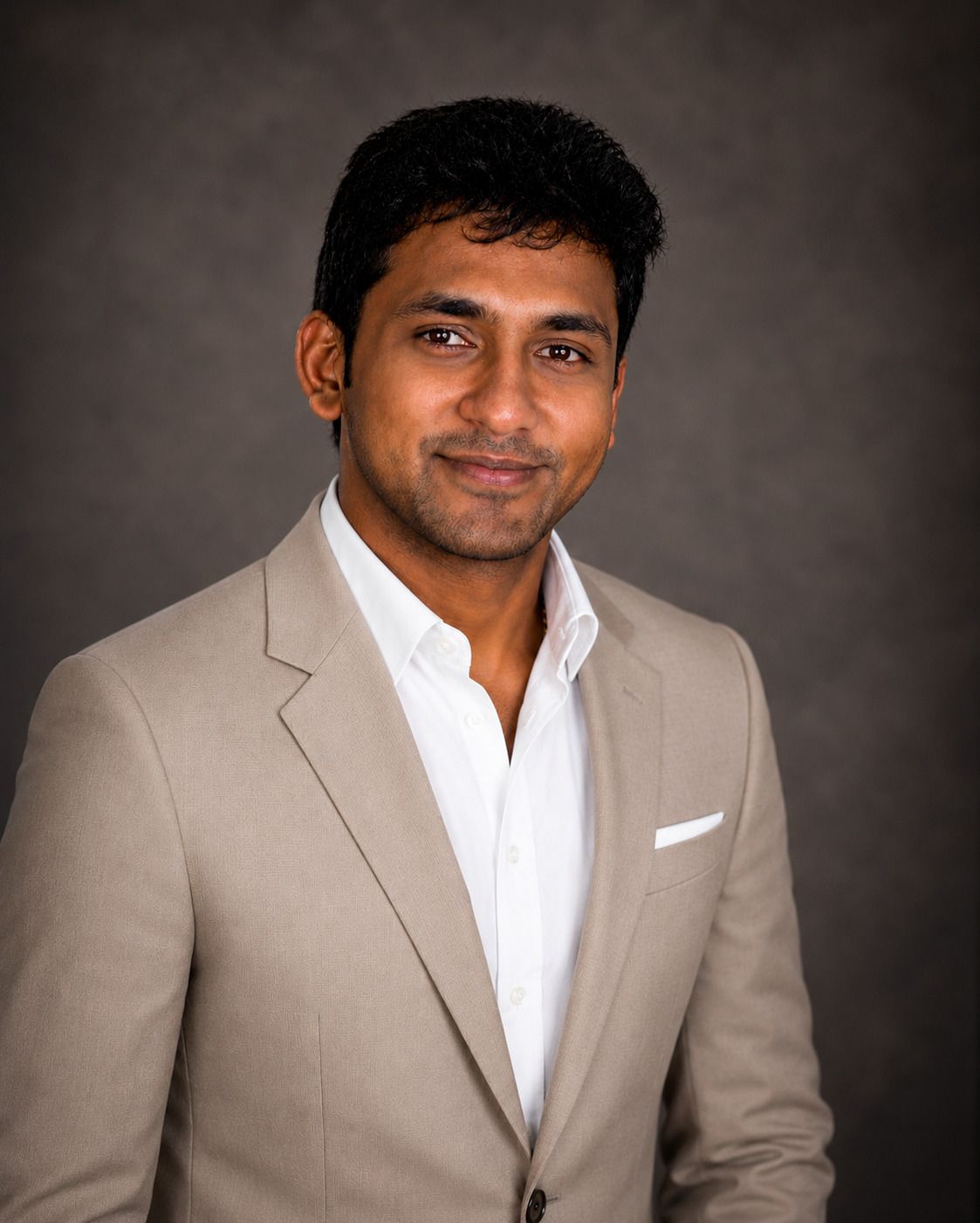
EPAT Alumni Story
Manikandan K
A chartered accountant turned independent quant researcher, Manikandan moved from discretionary, mood-driven trading to evidence-based quantitative research. Through EPAT he learned to model volatility, reason in market regimes, and back-test every idea before deploying capital. Today he builds research workflows in Python and, as his LinkedIn post put it, "the pursuit of alpha continues."
Most chartered accountants build careers around certainty. The numbers reconcile, the tax filings are due on fixed dates, and the work rewards precision and repetition. Manikandan K started down exactly that path, mastering financial reporting, audit, and tax like everyone else in his cohort. Then a single subject in his CA curriculum cracked the door open to a very different world.
Strategic financial management, one of the eight subjects in the chartered accountancy program, introduced him to derivatives, options, and portfolio construction. "There is a world which revolves around finance," he recalls thinking. That spark sat quietly for years while he did the conventional work, until curiosity pulled him from investing into equities, then futures, then options, and eventually into a question he could not shake: why did his discretionary trading feel fundamentally unsustainable, even when it worked?
This is the story of how a chartered accountant with no coding background transitioned from discretionary decision-making to evidence-driven quantitative research, and why he now describes himself as an independent quant researcher chasing alpha.
From Ledgers to Live Markets
Manikandan's route into trading was gradual and self-directed. Coming from a science background, he chose chartered accountancy because he liked how the course "molds a person," and he spent his early years doing the standard work of financial reporting, audit, and tax. But the theory he had absorbed in strategic financial management kept nagging at him. "I am a chartered accountant and I have studied theoretically, I should apply it, at least for my sake," he remembers deciding.
He began with investments, then moved deeper. Where he lives in the south of India, he observed, wealth traditionally revolves only around real estate and gold. "People don't have an idea about the modern financial products," he says, and for a while he considered starting an investment planning consultancy to fill that gap. The more he traded, though, the more a doubt surfaced: this was not how institutions operated.
That gap between retail intuition and institutional method became the central problem of his journey. He kept asking practitioners whether what they did was sustainable over the long term, and the answers were unsettling. Even the government was warning that most traders lose money. Yet he knew chartered accountants who traded successfully. "People are saying this is not sustainable for a long term, but the people in my domain were doing it successfully. So what am I missing?"
Why Systematic Trading?
The honest answer, he eventually concluded, was that discretionary trading rests on the least reliable foundation of all: the trader's own mood. "Our mindset will not be the same every day," he explains. "Sometimes when we are good, it is not good for the market. We can tend to be overenthusiastic, punch in more orders." On a bad day, the same trader hesitates on a genuinely good setup.
He offers a small, telling example from his own testing. He was working a one-to-two risk-reward ratio, capped at two trades a day. The first trade won, and the day felt aligned. On the second trade, a good mood made the market "look so better," and he missed a small detail that turned into a loss. Frustrated at his own mistake, he broke his own rule and took a third trade he would never have taken on a normal day. It backfired too. "Even when your mood is good it can backfire, and even when your mood is not better it can go another way," he says. He realised that the largest source of uncertainty wasn't always the market—it was the decision-making process itself.
Systematic trading offered the obvious antidote. "The main specialty of systematic trading is your mood has got nothing to do with this. That itself is a major win." The biggest advantage of systematic trading isn't simply removing emotions. It's ensuring every trading decision is supported by research, historical validation and a repeatable process before capital is ever deployed. More importantly, the transition wasn't from manual trading to automation. It was from opinions to hypotheses. Every trading idea became something to test rather than something to believe.
Why EPAT?
Before EPAT, Manikandan tried to close the gap on his own. A friend introduced him to how US markets operate, and he took courses covering concepts beyond standard technical indicators, things like fair value gaps and order blocks. He learned them, but the missing link remained. "This is not sustainable for a long term. I should do something different to take it long term."
When he came across the EPAT curriculum, it read differently from everything else he had studied. It promised the structured, institutional approach he had been circling for years without being able to name. He looked at the syllabus, liked what he saw, and enrolled. The appeal was not a single trick or indicator but a complete way of thinking about markets, from hypothesis to back-test to execution.
What EPAT reframed for him most sharply was the relationship between analysis and action. In discretionary options trading, he notes, most people watch volatility and open interest, then reach a conclusion and punch in a trade based on a strategy. "They see the volatility, but they don't use it the way quant people use it." EPAT taught him to treat volatility not as a passing observation but as something to model and act on deliberately.
The Volatility Aha Moment
Ask Manikandan which idea from the program stayed with him, and he does not hesitate. "I had no idea that volatility could often be modelled more reliably than price direction. That completely changed how I thought about risk management and options strategies. That itself was a big aha moment." Across years of self-study and even his CA curriculum, he had never encountered the notion that you could forecast volatility more reliably than direction, then build a trade around it.
The insight reshaped how he thinks about edge. "Predicting volatility is much better than predicting the prices," he says, and using that, "we can trade." Rather than betting on whether an asset rises or falls, he learned to reason about the range and behavior it is likely to exhibit, and to detect the market regime he is operating in. Different regimes call for different strategies, and news events, which discretionary traders are usually told to avoid entirely, become tradable when approached systematically. "Why are you leaving money on the table when you understand the ideas better?"
What made the concept doubly valuable was its reusability. The same volatility forecast that drives dynamic risk management on the equities side can seed entirely new strategies on the options side. "It's a multi-level use, all from the same derivations," he observes. One idea, learned once, paying off across several parts of his trading.
The Coding Hurdle
For a chartered accountant, the intimidating part of any quant program is the programming. Manikandan was candid about starting near zero. "The last code I did was during my school days, C and C++, a very basic level," he says. For years afterward he wrote no code at all. Ahead of the program he spent a few hours on basic Python through YouTube lectures, enough to grasp the shape of it, but no more.
EPAT, he found, met him where he was. "They started from the ground root level, and the mentors were also very good at teaching from the ground root level," he says. Because the material assumed no prior experience, coding never became the barrier he had feared. "I don't think coding was a hurdle for me to understand the concepts." Today, he is comfortable building research workflows in Python, implementing statistical time-series models and continuously improving his programming skills.
His approach to that practice reveals something about his temperament. When he gets an idea, he tries to translate it into code himself before reaching for help. Errors come, and he works back through them on Google Colab, asking what was wrong with his thinking. The mentors reinforced this, showing him not just fixes but which sources to consult when stuck. The result is understanding that sticks rather than answers that evaporate.
EPAT and the Role of AI
Given how easy it would be to lean on large language models for every coding problem, Manikandan is deliberately restrained. "I don't want to go to an LLM immediately. I want to think for myself, because that creates a much better understanding of what is happening," he explains. For him, understanding always comes before optimisation. The objective is not simply to produce working code, but to understand why the underlying model behaves the way it does.
That discipline extends to how he sees AI reshaping his original profession, and it is the crux of his advice to other chartered accountants. The routine work that traditionally absorbs young CAs, particularly financial reporting and tax, is exactly the kind of task AI automates most easily. "The roles are going to get very limited," he warns. "More people need to venture into new horizons."
He is also alert to how AI and alternative data are expanding what quant work can do. He points to satellite imagery and credit card usage data being used to gauge whether a company is growing, or to measure footfall at a business. "This alternate data is being used much more prevalently than before," he notes, and connecting those disparate signals is precisely the kind of interrelation that excites him about the field.
Advice for Fellow CAs
Manikandan believes the chartered accountancy background is an asset in quant finance, not a liability, provided you know how to use it. "I see quantitative finance as an extension of the evidence-based mindset developed through auditing. Just as auditors gather evidence before forming an opinion, quantitative researchers gather evidence before accepting or rejecting an investment hypothesis. The discipline is remarkably similar”. We understand accounting, finance, auditing & how tax works," he says. That breadth, he argues, gives CAs "a knack" for the interconnected reasoning that finance rewards, whether on the sell side across risk management, quant trading, and research, or on the buy side.
The most transferable skill, in his view, is stamina. "CA students actually spend more than 14 hours every day sitting and studying," he says. "The same applies for quant. We need to sit, do research, study different things, and try different things." The willingness to focus for long stretches, which the CA grind instills, maps directly onto the demands of early quant work.
Curiosity is the second ingredient. Chartered accountancy, he points out, is never a single subject but a web of accountancy, tax, law, audit, and information systems that you learn to interrelate. "The same applies for quant. It is not just one field. You can apply the concepts you learned in various different ways." Predict volatility, and you can deploy it for risk management and in derivatives alike. For CAs weighing the leap, his message is simple: finance is a big ocean with many branches, and quant is one of the most rewarding places to swim.
Looking Ahead
Manikandan's ambition is unambiguous, if patient. "My long-term goal was to start a hedge fund." he says. He entered EPAT imagining he would build a strategy, capture alpha, and go independent quickly. The program changed that calculus. He now sees how much there is to learn about how large institutions actually operate before striking out alone.
So the near-term plan is experience. "I should join a hedge fund or a big institution where things happen on a large scale, to understand that better," he says, with the goal of founding his own fund in perhaps ten to fifteen years. In the meantime, balancing ongoing CA exams with quant study, he is working through a series of projects on the concepts he has learned, including experiments with SARIMA and GARCH models to strengthen his understanding of statistical forecasting and dynamic risk management before progressing to larger institutional-grade research projects.
For now, as his LinkedIn post put it, “The pursuit of alpha continues”. It is a fitting phrase for someone who spent years sensing that something was missing from his trading and finally found the structure to name it. The chartered accountant who once traded on mood now reasons in regimes, volatility forecasts, and back-tested hypotheses, and he is only getting started.
Next Steps
If you are just getting started with algorithmic trading, begin with the Quantitative Trading Free Learning Track. It includes beginner-friendly courses covering data basics, trading strategies, and coding for finance.
Once you are ready to go deeper, explore Quantra's Algorithmic Trading for Beginners Learning Track, which offers hands-on, application-focused modules to build your skills step by step.
For those looking for a comprehensive, guided journey with mentorship, live lectures, and career support, the Executive Programme in Algorithmic Trading (EPAT) provides a complete foundation for launching or accelerating a career in this field.
Schedule an EPAT counselling call
To understand if EPAT is the right choice for you, talk to one of our specialists who have counselled thousands of learners over the past decade and helped them make the right career decision.