

Listen to the Podcast!
Introduction
For over two decades, a single rule shaped the landscape of US retail day trading more than almost any other: the Pattern Day Trader (PDT) rule.
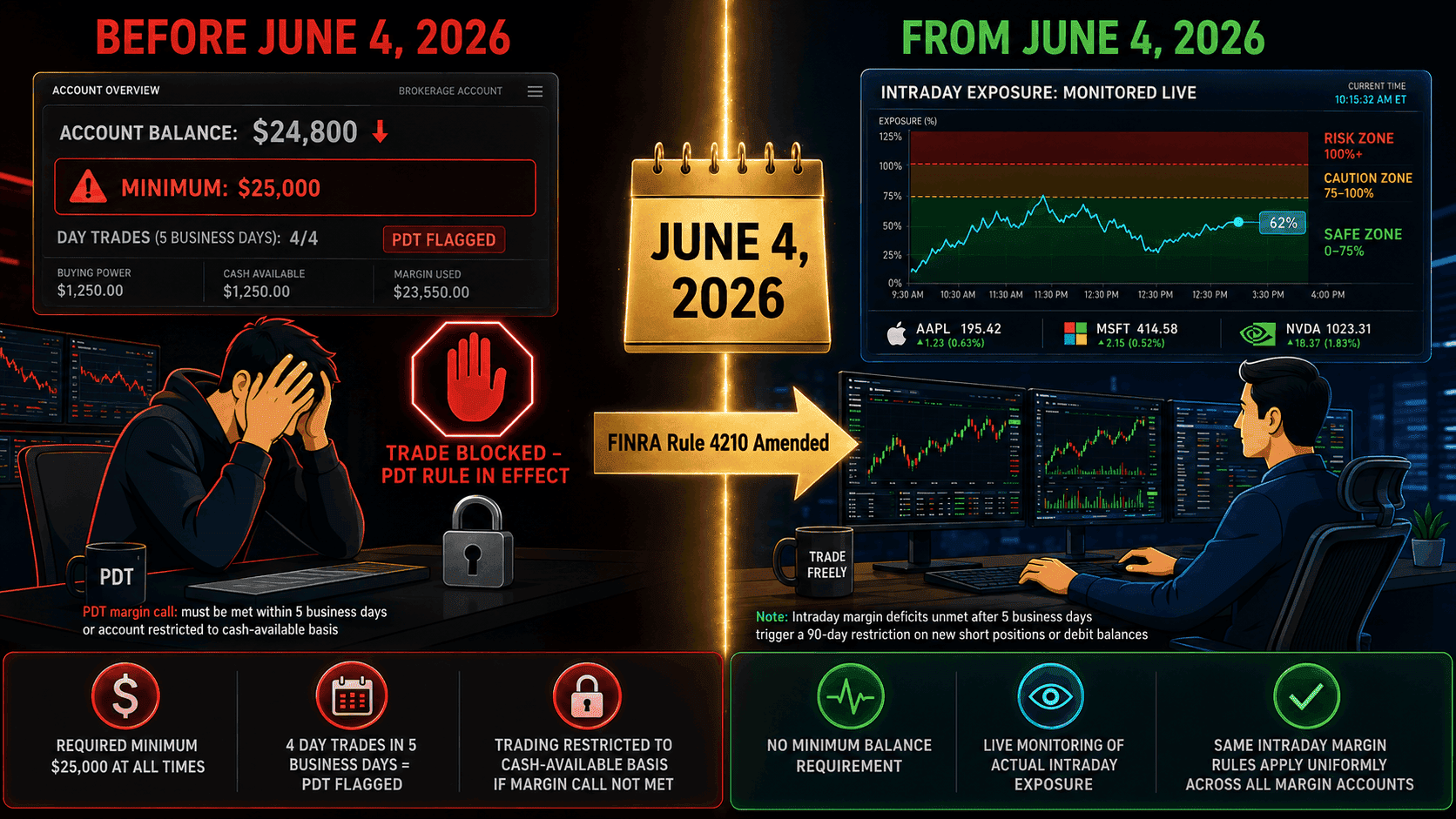
Embedded in FINRA Rule 4210, this requirement mandated that any trader who executed four or more day trades within a five-business-day rolling window in a margin account - a "Pattern Day Trader" - maintain a minimum of $25,000 in equity in that account at all times.
Fall below the threshold and you could no longer day trade. For millions of retail traders without $25,000 to dedicate to a brokerage account, it wasn't a warning - it was a wall.
That wall comes down on June 4, 2026.
The SEC approved FINRA's proposed amendments to Rule 4210 on April 14, 2026. The changes replace the PDT framework entirely, substituting a modernised intraday margin standard that better reflects how trading actually works in today's markets. Here's a comprehensive breakdown of what's changing, what isn't, and what it means if you trade US markets.
What Was the PDT Rule?
The Pattern Day Trader rule was introduced in 2001 by FINRA (operating at the time as NASD), in the aftermath of the dot-com bubble. The concern driving the rule was straightforward: retail traders with small accounts were using margin to take on excessive intraday leverage, frequently blowing up their portfolios and contributing to market instability.
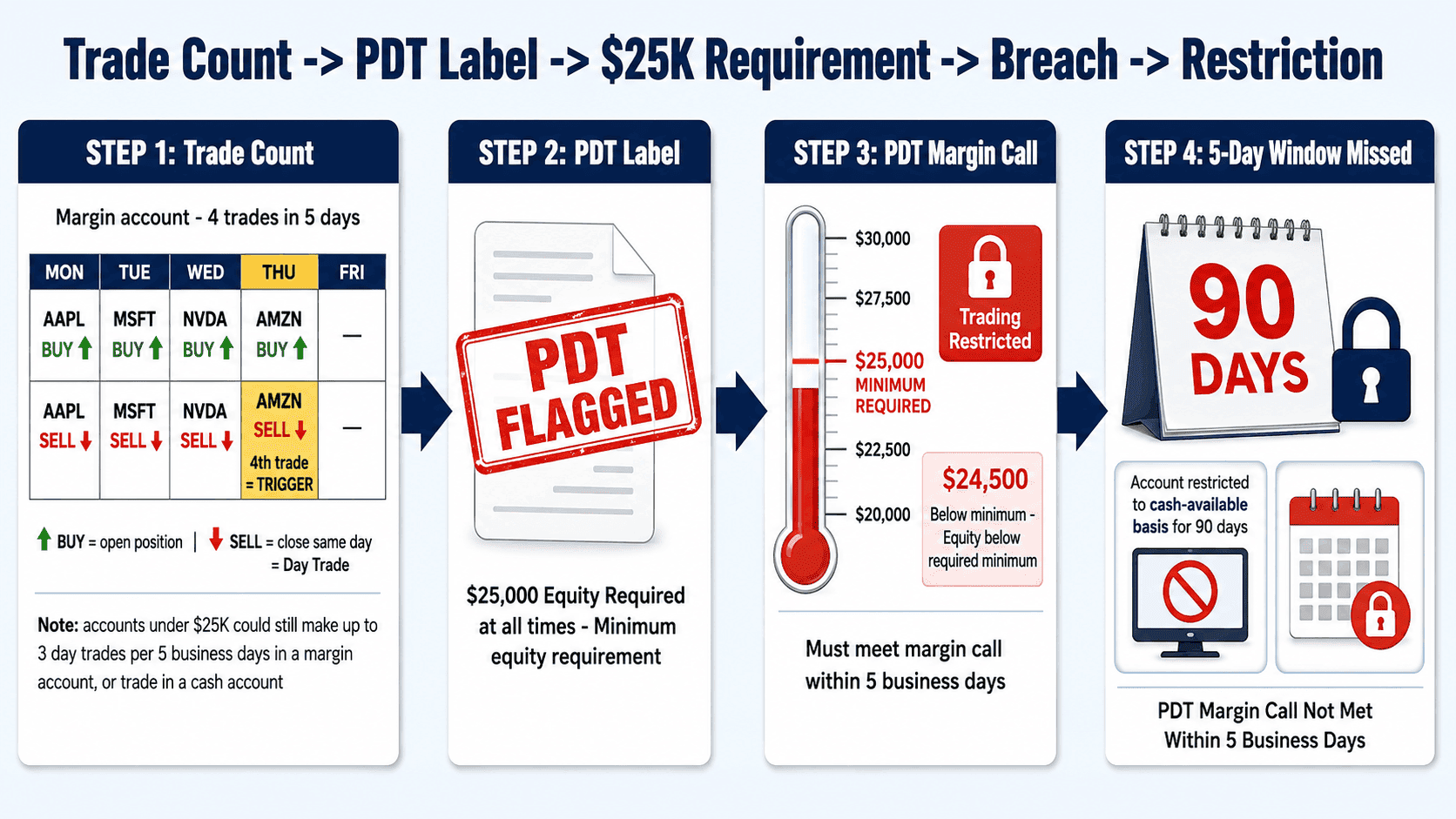
The regulatory response was to create a special category - the "Pattern Day Trader" - and impose heightened requirements on anyone who met the definition.
The definition:
A Pattern Day Trader was any customer who executed four or more day trades within any five consecutive business days in a margin account, provided those day trades represented more than 6% of their total trades over that period. (The 6% threshold was a small carve-out that rarely applied in practice.)
The requirements:
- A minimum equity balance of $25,000 in the margin account, maintained at all times
- The ability to trade up to 4x day-trading buying power (calculated as prior-day equity minus maintenance margin, multiplied by four)
- If a margin call arose from PDT activity, the trader had five business days to meet it - or trading was restricted to a cash-available basis for 90 days
For accounts that didn't meet the $25,000 threshold, the restriction was simple: no pattern day trading allowed.
What Is Changing from June 4, 2026?
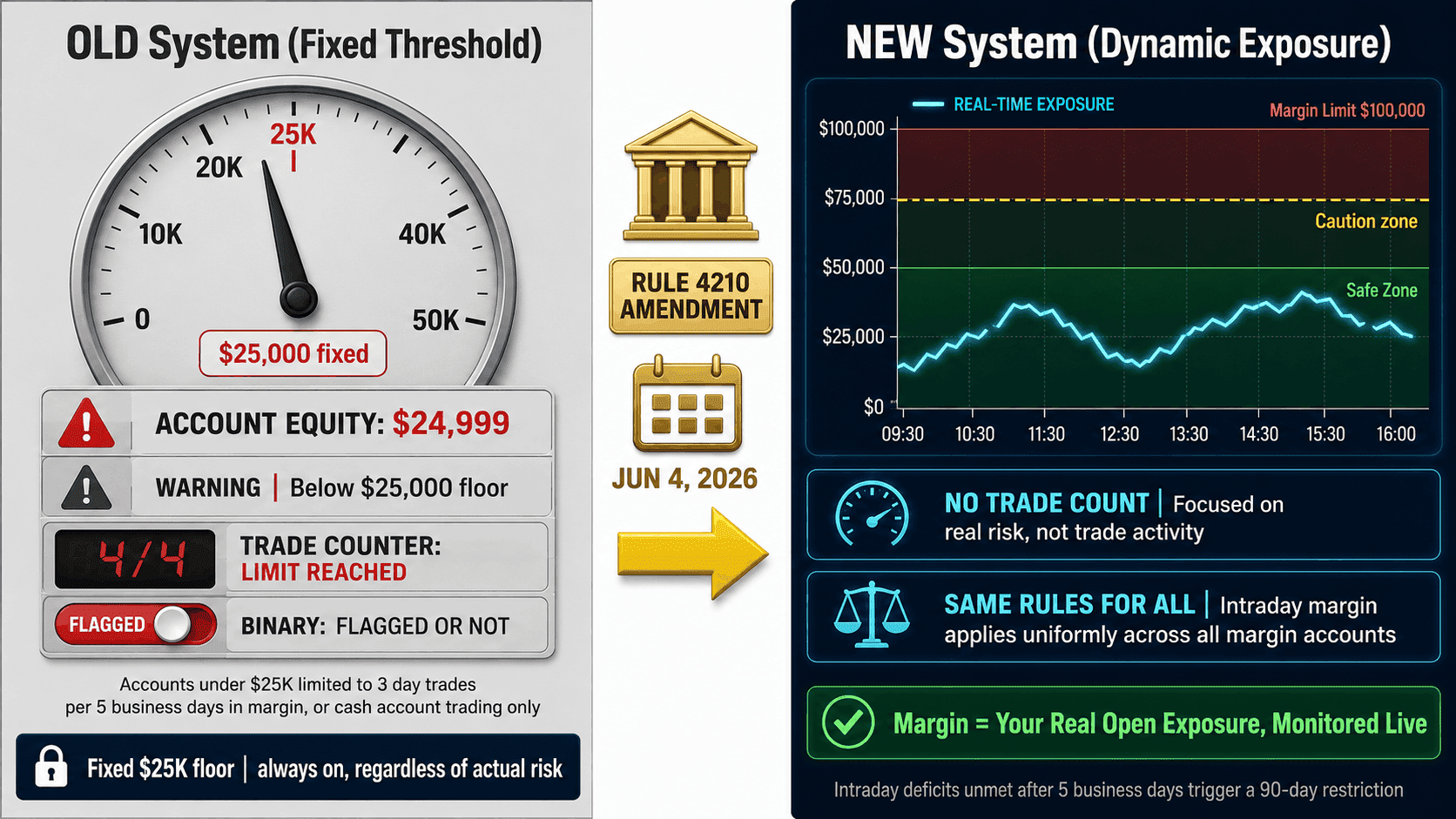
The amendment to FINRA Rule 4210 eliminates the entire Pattern Day Trader framework and replaces it with what FINRA calls an intraday margin standard. Here are the specific changes:
1. The PDT Designation Is Abolished
Broker-dealers are no longer required - or permitted - to classify customers as "Pattern Day Traders." The definition, the tracking obligation, and all requirements tied to that label are removed from the rule.
You can execute as many day trades as your account supports without hitting a trigger count. There is no four-in-five-days threshold anymore.
2. The $25,000 Minimum Is Removed
The mandatory minimum equity requirement of $25,000 that was tied to PDT status no longer exists in the rule. Retail traders with smaller accounts can now day trade in margin accounts without needing to maintain a specific dollar floor.
This is arguably the most impactful change for retail traders who have been shut out of intraday trading by the equity requirement.
3. The 4x Day-Trading Buying Power Is Eliminated
The special "day-trading buying power" calculation - which gave PDT accounts 4x leverage on intraday trades - is removed. All accounts will now operate under standard Regulation T margin requirements (generally 2x for standard margin, or 50% initial margin on equity positions).
4. A New Intraday Margin Monitoring Framework Is Introduced
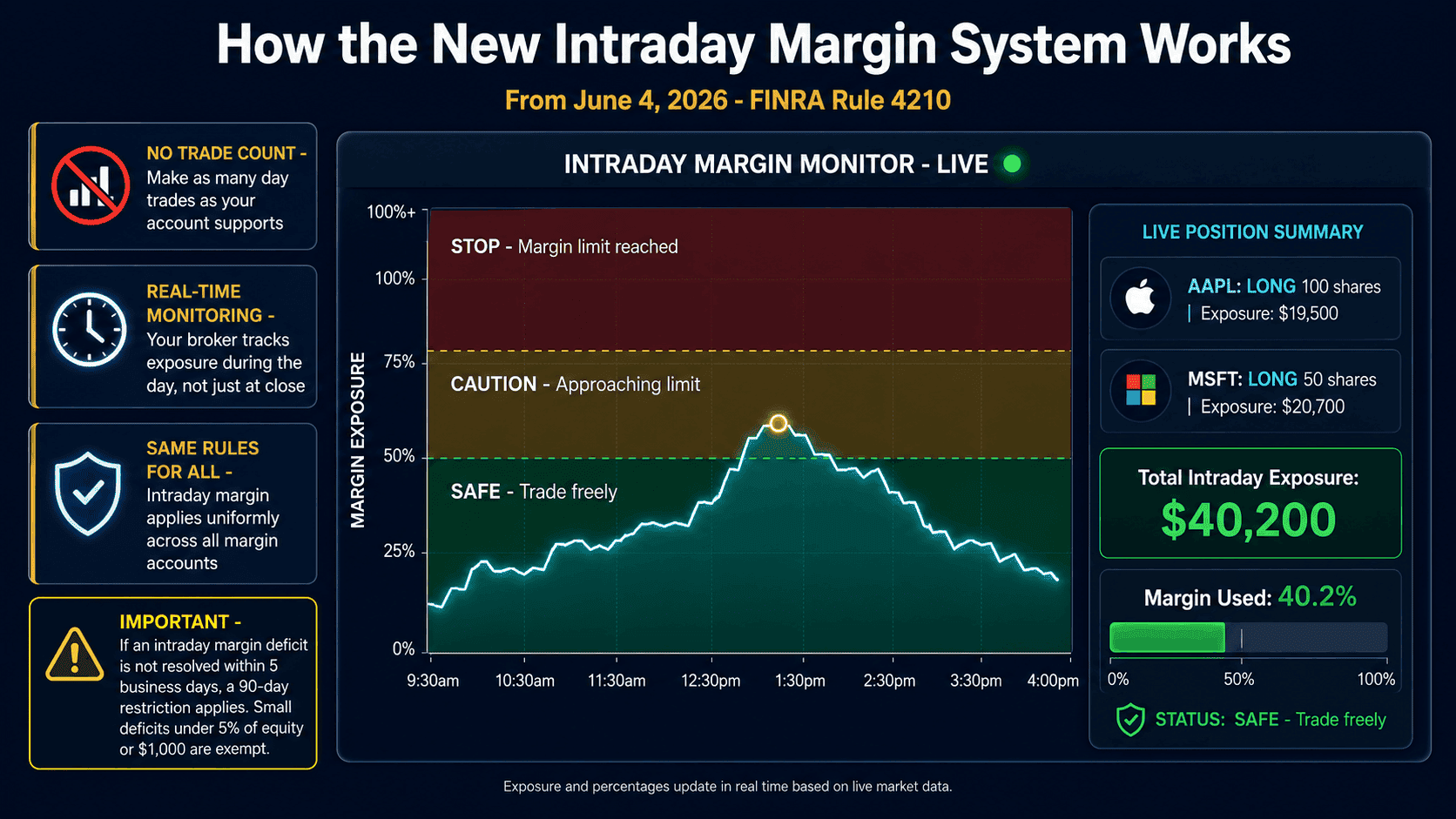
This is the substantive replacement. Under the new rule, broker-dealers must monitor the intraday margin positions of all customer margin accounts - not just those of designated PDT traders.
Member firms must either:
- Implement real-time systems to prevent trades that would create an intraday margin deficit, or
- Calculate end-of-day intraday margin positions and issue margin calls for any deficits that occurred
The margin calculation is based on a customer's actual open position exposure during the trading day - a dynamic, real-time assessment rather than a static prior-day equity figure multiplied by a fixed factor.
What Is NOT Changing?
It's important to be clear about what remains in place:
Standard margin requirements still apply.
Regulation T's initial margin requirement (typically 50% for equity securities) remains. FINRA's maintenance margin requirements - generally 25% of current market value for long positions - remain.
Margin calls still happen.
The new intraday monitoring framework may result in margin calls being issued faster and more dynamically than before - potentially in real time if a broker implements real-time blocking.
A margin account is still required.
To use margin for day trading, you still need a margin account with your broker. Cash accounts remain subject to settlement rules (T+1 settlement for equity trades as of 2024).
Broker implementation timelines vary.
FINRA has given member firms up to 18 months - until October 20, 2027 - to phase in the new framework. Your broker may not change their systems on June 4, 2026. Check directly with your brokerage for their specific timeline.
Intraday margin deficits can still result in a 90-day freeze.
Under the new framework, if an intraday margin deficit is not met by the close of business on the 5th business day after it occurs, the account is frozen from creating or increasing any short position or debit balance for 90 days. There is a small-deficit carve-out: if the shortfall is the lesser of 5% of account equity or $1,000, this 90-day restriction does not apply.
Why This Matters for Retail Traders
The PDT rule has been debated for over two decades. Supporters argued it protected inexperienced traders from leveraged blowups. Critics - and there were many - argued it was paternalistic, inequitable, and primarily served to disadvantage smaller retail traders while institutional and high-net-worth participants operated without similar constraints.
The removal addresses a legitimate structural inequity: under the old rule, a trader with $26,000 could day trade freely, while a trader with $24,999 doing the exact same activity was penalised. The determining factor wasn't risk, strategy quality, or trading acumen - it was a fixed dollar figure set in 2001.
The new intraday margin standard is, in principle, more proportionate: it assesses actual exposure rather than applying a blunt threshold.
For US retail traders, the practical implications are significant:
- Smaller accounts can now access intraday margin. The $25K barrier is gone.
- Strategy design is no longer constrained by a trade count. Systematic and algorithmic traders who deliberately kept intraday trades below four per five days to avoid PDT status no longer need that constraint.
- Risk management discipline becomes more important, not less. The removal of the PDT guardrail means traders need to be more thoughtful about their own margin usage and position sizing. Brokers will monitor intraday exposure, but traders should be doing the same.
What Should You Do Before (and After) June 4?
Step 1: Read the actual rule
Go to the official source: FINRA Rule 4210. On the right side of the page, use the version selector. Select the version applicable through June 3, 2026 (current), and compare it with the version effective from June 4, 2026. Reading the primary source is always the best starting point.
Step 2: Talk to your broker
Ask your brokerage how they are implementing the new intraday margin framework, and when. Given the 18-month phase-in allowance, your broker's platform may still show PDT rules or restrictions even after June 4. Get their timeline and understand how they'll communicate intraday margin situations to you.
Step 3: Revisit your trading strategies
If you've built systematic strategies specifically designed to stay within the PDT trade count limits - you may want to evaluate whether those constraints should be relaxed or removed. This is also a good moment to build in explicit intraday margin tracking to your strategy framework.
Step 4: Build margin literacy
Understand the new intraday margin concept. Know how your broker calculates your intraday buying power under the new rules. Know what triggers a margin call under the new framework. This knowledge is foundational to trading safely in a margin environment.
A Note for Algorithmic and Systematic Traders
For those building rule-based or automated strategies, the PDT rule elimination opens up new possibilities - but also new responsibilities.
The old rule effectively limited trade frequency for undercapitalised accounts, which had the unintended effect of forcing some traders to think carefully about trade selection. With that external constraint removed, the internal discipline of your strategy - position sizing, drawdown management, intraday exposure limits - matters even more.
The most robust systematic trading frameworks already incorporate dynamic risk controls that account for real-time exposure. The new regulatory framework is essentially requiring brokers to catch up to what good traders already do.
Understanding margin mechanics, backtesting with realistic margin assumptions, and building strategies that respect risk limits at the position and portfolio level are foundational skills in algorithmic trading.
Summary: Key Points at a Glance
| Feature | Before June 4, 2026 | From June 4, 2026 |
|---|---|---|
| PDT Designation | Yes — triggered by 4+ day trades in 5 days | Eliminated |
| $25,000 Equity Requirement | Required for PDT accounts | Removed |
| Day-Trading Buying Power (4×) | Available to PDT accounts | Removed |
| Intraday Margin Monitoring | Applied only to PDT accounts | Required for all margin accounts |
| Margin Basis | Prior-day equity × 4 | Real-time intraday exposure |
| Trade Count Tracking | Required by brokers | No longer required |
Conclusion
The elimination of the PDT rule on June 4, 2026 marks the most significant change to US retail day trading regulation in over two decades. For traders who have been held back by the $25,000 threshold, it removes a long-standing barrier.
But the change is not a relaxation of risk standards - it's a modernisation of them. The new intraday margin framework demands that both brokers and traders operate with a clearer, real-time understanding of market exposure. That's a higher standard of financial literacy, not a lower one.
If you're a trader in the US - whether you've been active or sitting on the sidelines - June 4 is worth marking on your calendar. Understand the new rules, know how your broker is implementing them, and make sure your trading approach is built on a rigorous foundation.
Serious about learning?
For a structured pathway that covers machine learning, deep learning, and their application in trading, the Executive Programme in Algorithmic Trading (EPAT) provides a comprehensive curriculum with a focus on practical implementation and real-world trading workflows.
Connect with an EPAT career counsellor to explore how it aligns with your background and goals:
Disclaimer: All investments and trading in the stock market involve risk. Any decision to place trades in the financial markets, including trading in stock or options or other financial instruments, is a personal decision that should only be made after thorough research, including a personal risk and financial assessment and the engagement of professional assistance to the extent you believe necessary. The trading strategies or related information mentioned in this article is for informational purposes only.