

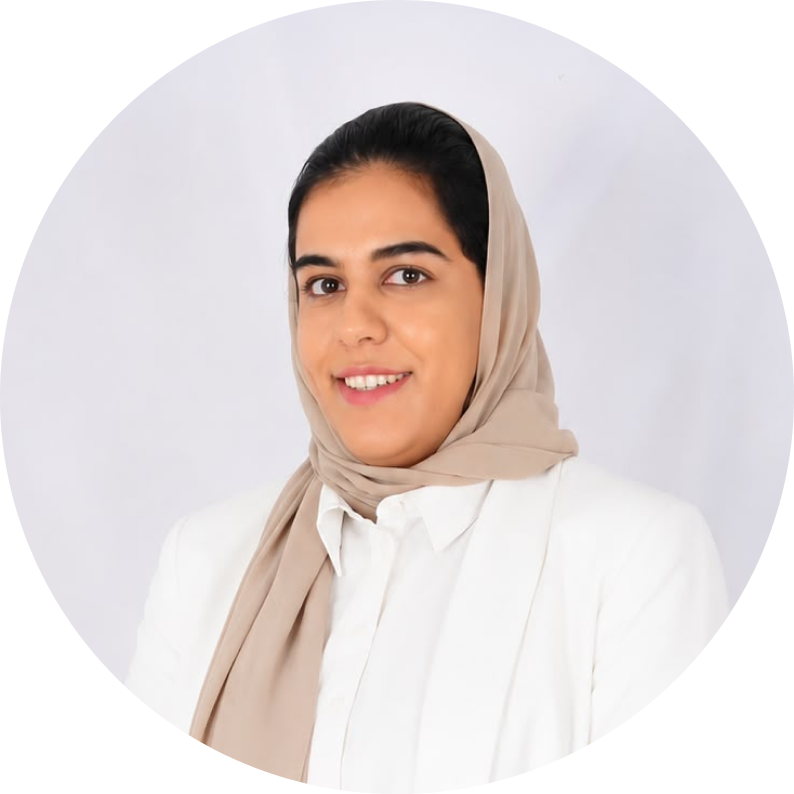
EPAT Alumni Story
Fatema Alkhabbaz
A Senior Treasury Analyst in Bahrain, Fatema moved beyond the conventional finance path to build her own edge in algorithmic trading. Through EPAT she learned Python from scratch, built a statistical arbitrage strategy, and grounded every idea in proper research and back-testing before deploying capital. Today she is laying the foundations for her own quantitative desk and, as she puts it, "now I have the tools that I can proceed forward."
In most treasury departments across the Gulf, the walls are lined with the same set of credentials. CFA. CISI. CPA. They are the traditional markers of a serious finance career, and Fatema Alkhabbaz worked alongside plenty of colleagues who held them. But she was looking beyond the conventional path, toward a field that was still taking shape in her market: algorithmic trading.
Fatema works as a Senior Treasury Analyst at a bank in Bahrain, where her role spans treasury projects, strategic initiatives, and long-range planning rather than day-to-day trading and dealing. She does not come from a quantitative or engineering background. Yet today, she is designing systematic trading strategies, writing Python from scratch, and laying the foundations for her own quantitative research capability. The bridge between those two versions of herself is the Executive Programme in Algorithmic Trading (EPAT).
Her story is less about a career switch than a career expansion, seeing where finance was heading, recognising an opportunity early, and deciding to build the skills to pursue it. At the time, algorithmic trading was not yet a mainstream conversation in Bahrain's treasury community. For Fatema, that was part of the attraction. The field was still open, and she wanted to learn how to build inside it.
Why Algo Trading?
The pull toward algorithmic trading had been there since 2019, quietly, but it kept slipping off Fatema's radar. What brought it back into focus was a change at work which exposed her to a part of the wider organization where algorithmic trading was already more established.
It gave her a glimpse of how differently a treasury function could operate, and made the direction feel tangible.
"They don't have traders, they actually have algo traders," she recalls. " From there, I understood that this was where the industry was heading." For someone whose job is to think about direction and strategy, the signal was hard to ignore. She saw two opportunities layered on top of each other. The first was institutional: she could develop the technical capabilities to help bridge the gap between traditional treasury and the more quantitative direction she was seeing across the wider group. The second was personal.
"I really want to learn algo trading for myself. I want to have my own private desk at home. I want to do something for myself," she explains. "So it was a two in one thing for me."
Importantly, this was not a mandate from above. This was not something she was required to pursue. She chose it herself, driven by curiosity, ambition, and the sense that she had found a field worth building into.
She wasn't waiting for a job title to tell her what to learn. She saw where the industry was moving and decided to build the capability herself.
Why EPAT?
Fatema did look at alternatives before committing. What set EPAT apart, in her assessment, was that it was practical rather than theoretical. That distinction mattered enormously given her goal. She was not looking for a credential to hang on a wall or a qualification that only opened doors inside an institution. She wanted to be able to build things herself and eventually put her own money to work.
"With EPAT I'm sure that I can see opportunities for myself. I can build things for myself," she says. "That's what differentiates EPAT for me from any other professional course." She also framed the decision in the language of her own discipline. To a treasury professional, everything is a question of value and return. "It has a better value for money, a better ROI, compared to any other courses I found in the market."
When she finally looked at the curriculum, the hesitation vanished. "I just made the decision. I took my savings and made this investment," she recalls. "When I looked at the agenda, when I looked at the topics, I found this is what I want to do, and I just signed up."
Learning Python With a Purpose
Python was not new to Fatema in the sense that she had tried, several times, to teach herself. It was new in the sense that none of those attempts had stuck. "I tried to learn Python many times at home alone using YouTube, but because I didn't use it, I kept forgetting it," she says. In early 2025 she took it more seriously, working through online courses, but something was still missing. The material was generic. It taught data, but it did not connect that data to finance, trading, or treasury. "I was learning data, but I was not applying it."
EPAT changed the equation by giving the learning a spine. "With EPAT I really learned Python from scratch. It was structured, it was clear, it was grounded in finance," she explains. The difference was purpose. When each concept was tied to a reason she cared about, the knowledge finally held. "Because I had a purpose, it was easier for me to learn. It was easier for me to know what I was doing and how to use it."
That shift, from abstract tutorials to grounded application, is a recurring theme for career changers who arrive at EPAT without a programming background. The code becomes learnable precisely because it is attached to a problem worth solving.
How EPAT Rewired Her Thinking
Ask Fatema what changed during the programme and she does not reach for a single feature. She reaches for the way she thinks. "It changed the way I think in general. It rewires your brain and how to think," she says. The sharpest shift was in her understanding of what algorithmic trading actually involves.
Before EPAT, she had absorbed the popular version of the idea, the one sold by consumer trading apps where automation is treated as the whole game. She is blunt about the flaw in that picture. "People automate the trade and they think they're doing a good job, even though they automate their losses, not their profits." What EPAT gave her instead was the discipline that is supposed to come first.
"In EPAT you have the actual structure, the actual research, the actual science behind what you're doing," she explains. She describes the groundwork that precedes any deployment: a proper backtest, the honesty not to cheat on that backtest, the vigilance against overfitting, and even the step of testing the backtest itself with tools like a confusion matrix. "There is a lot of work to do before just automating the trade. After you have the research and everything, then you can say, okay, now it's time to automate and deploy this into production." She calls that framework a game changer, then reconsiders and lands on something more foundational. "Maybe it's a good foundation, honestly."
Not every module went down smoothly. She is candid that one stretch tested her. "The only thing that gave me a panic attack was options and volatility trading," she admits, laughing at the memory. But the statistics modules were where she found her footing and her fascination, from ARIMA to ARCH and GARCH, and above all statistical arbitrage. "This was like magic for me. You long a few assets and short some, and you have the spread, and from this spread you make the P&L. This strategy for me was like, wow."
The Capstone: Statistical Arbitrage
That fascination became her capstone project. Working with a mentor, Fatema built a statistical arbitrage strategy, but the real value was in the questions the mentor kept pushing back at her. "He always let me question myself," she says. One of those questions reframed how she thought about edge.
The strategy produced a modest but stable return, and the mentor pressed her to compare it against a simpler alternative. What if, during a strong momentum period, she had just gone long the assets instead of arbitraging them? She would have captured more upside. But the comparison sharpened her appreciation of what arbitrage actually offered. "It's only six percent profit in maybe six months, but it has very low drawdown, and I can add leverage into it. Instead of six I can make twelve percent P&L with a drawdown of maybe two percent." The point was not raw return. It was return per unit of risk, and the control that comes with it.
The mentor also pushed her toward walk forward optimization, running simulations in her code to see how the strategy might behave in a live market and using those results to refine it. "The thought process and the analysis, I learned so much from it," she says. "I have the engine itself."
Interestingly, statistical arbitrage will not be the first strategy she deploys with real money. She has thought carefully about sequencing. "Part of me doesn't want to start with shorting as my first strategy," she explains, noting the operational complexity that short selling adds. Her plan is to begin with long only and momentum strategies, get comfortable with live operations, and then fold statistical arbitrage in as one sleeve of a larger portfolio. "Once I feel comfortable, I will add more operational complexities. That's my perspective." It is a measured, risk-aware roadmap, the kind that reflects a treasury mind more than a gambler's.
The Future of Treasury Is Quantitative
One line from Fatema's own writing captures her larger thesis: the future of treasury is quantitative. She means it concretely, and her experience in treasury has given her a close view of what that transition requires.
The shift toward quantitative treasury, she argues, starts with something less visible but equally important: data and infrastructure readiness. Applying quantitative methods in a banking environment is not simply about building models. It requires reliable, structured data, the right infrastructure, and processes that make that data usable.
Fatema has increasingly focused on the technical foundations needed to support more quantitative decision-making within treasury: understanding how data is sourced, structured, cleaned, and prepared for analysis, while also considering how the underlying infrastructure needs to evolve to support automation and future quantitative models.
For her, this foundation is essential. "You cannot build the brain without the data and the infrastructure," she explains. The goal is to create an environment where data can be consistently prepared, monitored, and made ready for models and automation.
In her view, becoming more quantitative is not simply about developing algorithms. It is about building the infrastructure that allows those algorithms to work reliably in a real banking environment.
Looking beyond her current work, she describes wanting to develop a more robust quantitative framework for FX warehousing, one that could incorporate market conditions, macroeconomic signals, momentum, currency carry, and sentiment into a systematic scoring framework. "That's more robust than manual monitoring," she says. "In the world of banking now, every second matters."
For Fatema, quant is not a niche specialization bolted onto treasury. It is the underlying engine. "Quant is the main engine, the brain. You're building the brain of how everything is going to work and automate."
EPAT and the Role of AI
Fatema is refreshingly practical about how she closes the gap between what she knows and what a project demands. Her advice to people from a similar background is straightforward: do the actual work yourself, take on projects that stretch your capabilities, and use modern tools to accelerate the learning process.
"Even at my job, I started to focus on that direction, take on the technical side of projects, digging deep into the details," she says. "Even when I didn't know coding much, I have my secret amazing method: on-the-job learning. Do your own research, ask AI, learn, apply, and move forward."
For Fatema, AI is not a substitute for understanding the work. It is a tool that helps her move faster from a question to research, experimentation, and application. That mindset has allowed her to take on increasingly technical projects while continuously building her skills along the way.
She also values that EPAT has not treated its curriculum as finished. "After I graduated, I keep seeing them update the content. They are adding things about AI agents," she notes, pointing to it as one reason she recommends learning from a single, maintained source rather than stitching together scattered tutorials. The combination she describes, structured foundations from EPAT and AI as an everyday collaborator, is exactly how many practitioners now move from idea to implementation.
Looking Ahead
At the time of this conversation, Fatema was roughly a month past her capstone, having taken a long break before returning to build in earnest. She has a time plan. The first strategy is in research and development now, with a goal of having something ready for live testing by October. "By then I think I can have a proper answer," she says, referring to how the strategy performs in live conditions.
Her ambitions are not confined to her own portfolio. Recognising that algorithmic trading is still an emerging field in Bahrain and the wider GCC, she offered to help change that as an EPAT ambassador in her country, including connecting the programme with leading local institutions in banking and finance. Her reasoning is characteristically direct. Fresh graduates in a crowded market, she argues, do not need to pile on yet another traditional certificate. "People should focus on this, because it's the future. Actually, it's not the future, it's the present." She also sees a chance to reach her community in its own language. "I can reach them in Arabic. I'm already thinking of doing some social media. It will be a win win."
Fatema Alkhabbaz set out to do two things at once, to bring something new to her institution and to build something of her own. What connects both is the conviction that started her journey and now defines it. The tools exist, the discipline can be learned, and the space is wide open for whoever moves first. "Now I have the tools that I can proceed forward," she says. For her, that is not the end of the story. It is the foundation.
Frequently Asked Questions
Do I need a quantitative or engineering background to move into algorithmic trading? No. Fatema came from a treasury and finance background rather than engineering or computer science. A structured programme can teach the programming and quantitative methods from the ground up, and existing finance experience often transfers directly into strategy design and risk thinking.
Is programming knowledge required before starting EPAT? It helps, but it is not a prerequisite. Fatema had tried to learn Python on her own several times without it sticking. She found the code became learnable through EPAT because it was tied to finance and trading problems she cared about, rather than taught in the abstract.
Can algorithmic trading skills be applied inside a treasury or banking role? Yes. Fatema is applying quantitative methods to treasury work, including data and infrastructure readiness and a more systematic approach to areas such as FX warehousing. Her larger thesis is that the future of treasury is quantitative, and that building the right data foundation comes first.
What is statistical arbitrage, and why was Fatema drawn to it? Statistical arbitrage involves going long some assets and short others to trade the spread between them. Fatema valued it for its low drawdown and the control it offers, prioritising return per unit of risk over raw return, with the option to add leverage carefully.
Should statistical arbitrage be a beginner's first live strategy? Not necessarily. Fatema plans to begin with long only and momentum strategies to get comfortable with live operations, then fold statistical arbitrage in as one sleeve of a larger portfolio, since short selling adds operational complexity.
How does Fatema use AI in her workflow? She treats AI as a tool to move faster from a question to research, experimentation, and application, not as a replacement for understanding. Her method is on-the-job learning: do your own research, ask AI, learn, apply, and move forward.
How long does it take to build a working strategy after EPAT? It varies. At the time of the conversation, Fatema was about a month past her capstone, with her first strategy in research and development and a goal of live testing by October. Building something reliable takes testing and iteration rather than a single breakthrough.
Is algorithmic trading established in Bahrain and the wider GCC? It is still an emerging field there, which Fatema sees as an opportunity. She has offered to help grow it as an EPAT ambassador, including reaching her community in Arabic and connecting the programme with local banking and finance institutions.
Next Steps
If you are just getting started with algorithmic trading, begin with the Quantitative Trading Free Learning Track. It includes beginner-friendly courses covering data basics, trading strategies, and coding for finance.
Once you are ready to go deeper, explore Quantra's Algorithmic Trading for Beginners Learning Track, which offers hands-on, application-focused modules to build your skills step by step.
For those looking for a comprehensive, guided journey with mentorship, live lectures, and career support, the Executive Programme in Algorithmic Trading (EPAT) provides a complete foundation for launching or accelerating a career in this field.
Schedule an EPAT counselling call To understand if EPAT is the right choice for you, talk to one of our specialists who have counselled thousands of learners over the past decade and helped them make the right career decision.