

It's usually the first question people ask, often before they've written a line of strategy code, and the internet answers it with a wall of contradictory numbers: $1,000, ₹50,000, $25,000, ₹10 lakh. Several of those can be right at once, because the answer depends on what you trade, how often you trade it and how much fixed cost you carry. So rather than add one more number to the pile, let's work out where the number comes from, and then you can size your own account instead of borrowing someone else's figure.
So what's the real minimum?
There's no legal minimum for algorithmic trading itself in India. In practice the floor comes from three things: the smallest position your instrument allows, the fixed costs of running a system, and a sizing rule that stops any single trade from doing serious damage. For slow strategies in cash equities, a few lakh rupees is a workable start. For futures, options or frequent trading, you need meaningfully more, and it must be money you can afford to lose.
In the US, the $25,000 pattern day trader minimum is on its way out. That rule required anyone making four or more day trades in five business days in a margin account to hold at least $25,000. The SEC approved FINRA's replacement on 14 April 2026, effective 4 June 2026, swapping the minimum and the day-trade count for an intraday margin standard that applies to every margin account. Brokers have until 20 October 2027 to move over, so yours may still apply the old rule for a while, and the separate $2,000 minimum for opening a margin account isn't part of the change. Check how your broker handles it before you plan around it.
What sets the floor in India?
India has never had a rule like the PDT minimum. What sets the floor here is contract size. SEBI raised the minimum value of an index derivatives contract to ₹15 lakh from November 2024. The Nifty lot is currently 65 units (it changed from 75 with the January 2026 contracts, and NSE reviews lot sizes periodically, so check the current figure). At the Nifty's close of 23,140 on 25 September 2026, one lot is about ₹15 lakh of exposure.
Your broker will ask for a margin of roughly a tenth to an eighth of that (its margin calculator gives the day's figure), so a ₹3 lakh account can hold a lot with room to spare. On paper that sounds fine. But margin is a deposit, not a measure of risk. The risk is ₹15 lakh.
What does one lot actually risk?
This is where most small accounts go wrong, so it's worth doing the arithmetic. Over the past year the Nifty's typical daily move (one standard deviation) was about 0.8%, which on one lot comes to around ₹12,600. The worst day of the past year, 19 March 2026, was a fall of about 3.3%, or roughly ₹49,100. And on 23 March 2020 the index fell 13% in a single session, which at today's lot size and level would be about ₹1.95 lakh on one lot, in one day.
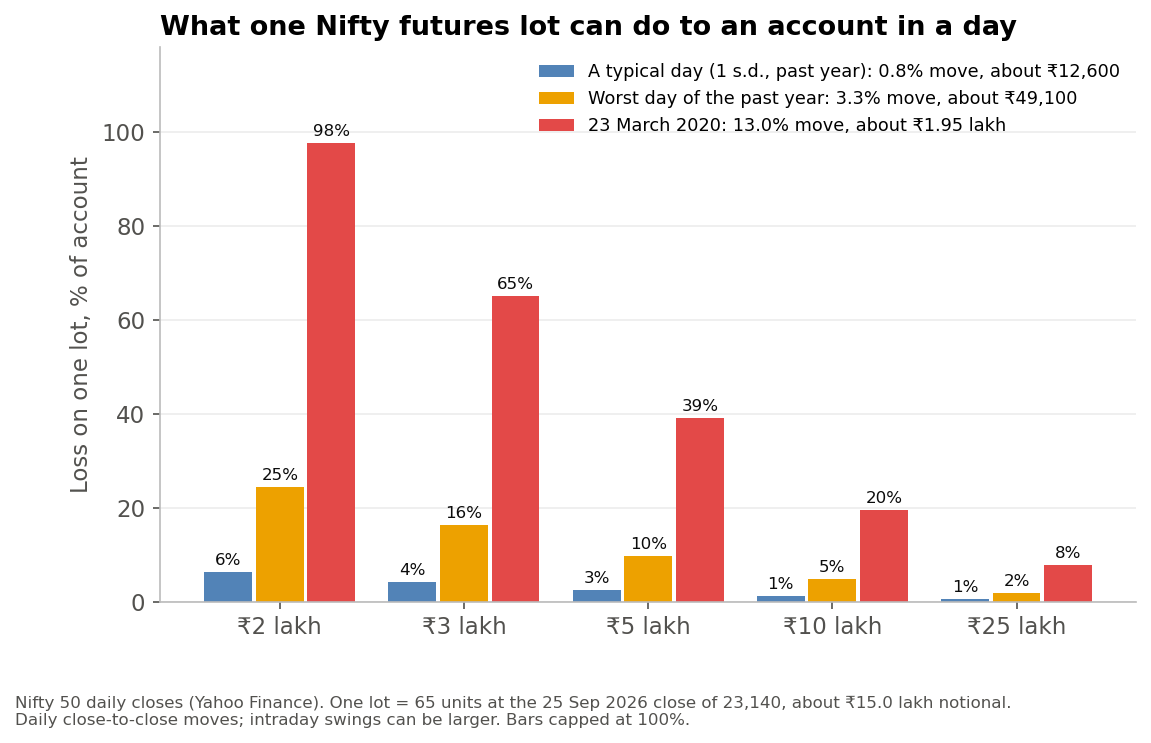
On a ₹2 lakh account, a normal bad day costs about 6%, the worst day of an ordinary year costs a quarter of the account, and a 2020-style crash takes almost all of it. On ₹10 lakh the same crash costs about a fifth, which is painful but survivable.
SEBI's own data shows the pattern. Its study of individual derivatives traders, published on 20 August 2026, found that 87.7% lost money in FY26. The loss rate was highest among the smallest accounts: 90% of traders using less than ₹1 lakh of margin lost money, against 67.6% of those using ₹10 lakh to ₹1 crore. (SEBI calls these capital-bracket figures indicative, since they come from a sample of about 5,050 traders.) Did a bigger account make traders profitable? No. Two-thirds of the larger accounts still lost money. But the undersized accounts did measurably worse.
Why do small accounts struggle with costs?
Running an automated strategy has costs that don't shrink with your account. There's market data, which costs about ₹500 a month from one large Indian broker. There's a small cloud server with a fixed IP address, so the bot runs without your laptop (about ₹700 a month at September 2026 list prices). And there's brokerage of ₹20 plus GST per order at a flat-fee broker. The chart shows what those add up to as a share of the account, at three trading speeds.
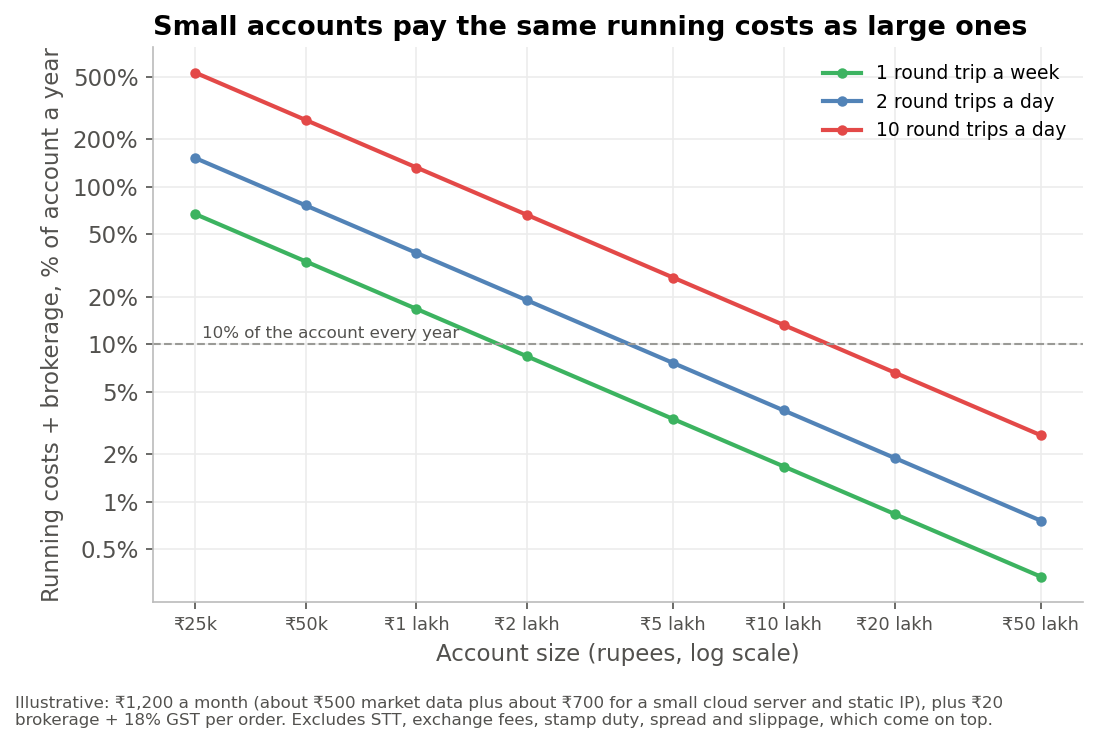
At one round trip a week (the green line), a ₹1 lakh account pays about 17% of its value each year in running costs and brokerage. At ₹10 lakh the same setup costs under 2%. Trade twice a day (blue) and the ₹1 lakh account needs to earn 38% a year just to cover them. That isn't a realistic target, which is why the small-account answer is almost always "trade less often" rather than "find a better strategy". (The weekly line is a slight overstatement, since many flat-fee brokers charge no brokerage on delivery trades, but the ₹1,200 a month doesn't go away.)
These costs also come before the ones that scale with trading: securities transaction tax (STT), exchange fees, stamp duty, GST and the bid-ask spread. Our article on transaction costs works through those.
How much should you risk per trade?
Once you know your instrument and your costs, the last input is sizing. A common rule of thumb among systematic traders is to risk a small, fixed share of the account on each trade, often 0.5% to 2%, meaning that if the exit point (the stop) is hit, you lose that fraction. It sounds overly cautious until you see what larger numbers do.
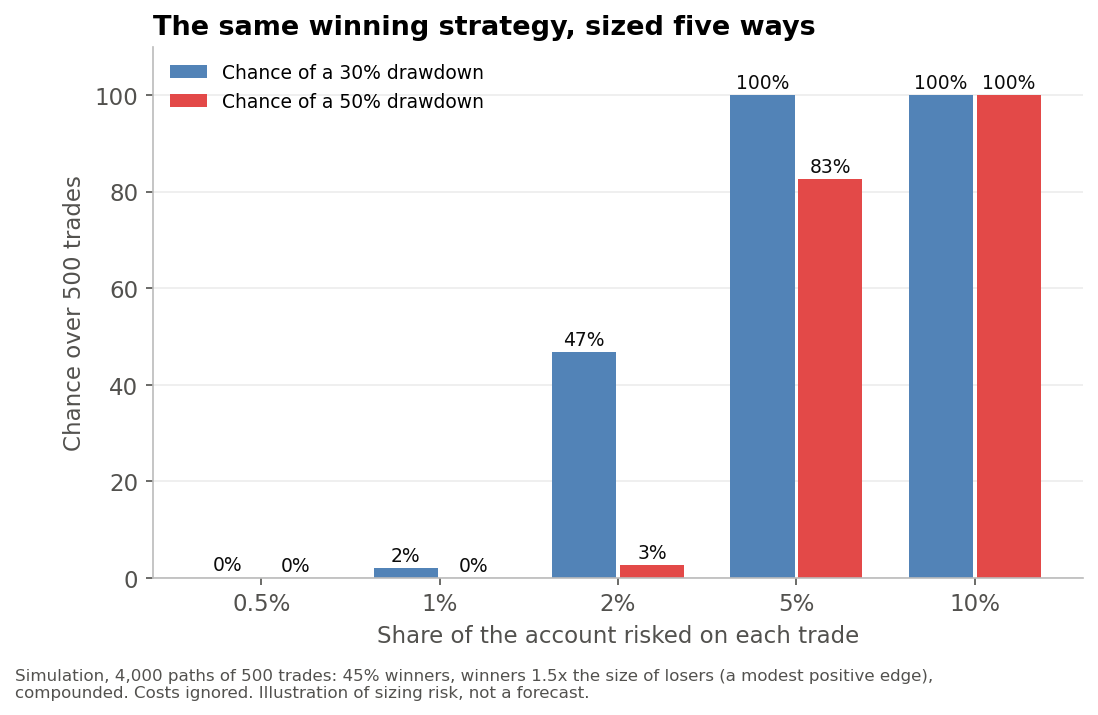
The simulated strategy has a real edge, and every version of it makes money on average. Yet at 2% risk per trade, nearly half the paths suffered a 30% drawdown (a fall of 30% from a previous peak) somewhere in their 500 trades. At 5%, every single path did, and 83% fell by half. At 10%, the median path lost about 90% from its peak at some point. The strategy and the edge are identical in every column, and only the size changes. For this strategy the size that maximises long-run growth, known as the Kelly fraction, works out at about 8% per trade, so the 10% column is already past it, where extra risk buys deeper drawdowns and slower growth. Most practitioners who use Kelly bet half of it or less, because the inputs are estimates.
The simulation is also kind in ways real trading isn't. It ignores costs, assumes the edge is real, and never lets losses cluster together, so real strategies usually do worse than this.
Now link that back to the lot. If your rule is to risk 1% per trade and your stop on a Nifty futures position is 1% away, one lot risks about ₹15,000, which implies an account of around ₹15 lakh. With a ₹3 lakh account, the same trade risks 5%, and you're in the column of the chart where losing half the account is a matter of time. (A 1% stop is also tight for an index whose ordinary daily move is 0.8%, so expect it to be hit often.)
And a stop doesn't cap the loss. If the index gaps through it overnight, or on a day like 23 March 2020, you're filled at the next available price, which can be far worse than the stop. Size for the gap you could survive as well as for the stop. This is why the real minimum for futures is set by the lot rather than the margin.
What are realistic starting ranges?
As rough brackets, not rules: for slow cash-equity strategies a few lakh rupees is a workable start, while futures, options or frequent trading need meaningfully more to absorb fixed costs and survive a bad day on one lot. The figures assume Indian markets, a flat-fee broker and money you can afford to lose:
Starting capital | What it realistically supports |
Under ₹1 lakh | Learning and paper trading. Small live cash-equity trades, a few a month, without paid data or hosting, since ₹1,200 a month would be a large share of capital. |
₹1 lakh to ₹5 lakh | Low-frequency strategies in cash equities or ETFs, holding for days to weeks. One futures lot is a large bet at this size. |
₹5 lakh to ₹15 lakh | A few uncorrelated equity strategies. At the upper end, an occasional single futures lot with a defined exit, sized for gaps. |
₹15 lakh and above | Room for more than one strategy and market, and for futures sized at around 1% risk per trade. |
None of these rows is a recommendation to trade derivatives. Futures and options are leveraged, losses can exceed the margin you post, and SEBI's data shows most individual derivatives traders lose money.
In US markets the low end is more flexible, because fractional shares and micro futures exist. The CME Micro E-mini S&P 500 contract is $5 times the index, a tenth of the full E-mini, and its exchange maintenance margin was about $2,300 to $2,600 per contract in late September 2026. That still means something like $35,000 to $40,000 of exposure per contract at recent index levels, so the same risk-per-trade arithmetic applies, and a broker offering far lower day-trading margin is raising your risk rather than lowering it.
More capital doesn't buy an edge, but it does buy room: the ability to size positions sensibly and to survive the drawdowns every strategy has. The edge has to come from a tested strategy and disciplined risk control, and that takes the same work whether your account is ₹2 lakh or ₹2 crore. (Our article on pre-made trading algorithms shows why testing is harder than it looks.)
How do I start with less?
Start without money, then with a little, then with more. Paper trade first: run the strategy against live market data with no real orders, so you find the bugs (expired logins, rejected orders, wrong lot sizes) for free. Then go live with the smallest size the instrument allows, in a market where that size is small relative to your account, which usually means cash equities rather than F&O. Scale up only after the live results have tracked the backtest over enough trades to mean something (50 to 100 is a reasonable minimum), with costs included.
This staged path is slower, and while you're learning, a few extra months cost far less than a blown account.
Frequently asked questions
Can I start algorithmic trading with ₹50,000 or $1,000?
You can start learning, and trade small cash-equity positions, but not with the full automated setup. At this size, ₹1,200 a month for data and a server is about 29% of ₹50,000 a year before a single trade. Paper trade first, run the bot on your own machine or on free broker data while you learn, and add paid data and hosting once the account can carry them. Derivatives are a poor fit, since one Nifty futures lot is about ₹15 lakh of exposure.
Is there a minimum capital requirement for algo trading in India?
There's no legal minimum for retail algo trading itself. The practical floor comes from contract sizes (SEBI's ₹15 lakh minimum for index derivatives), broker margin and the running costs of data and hosting. SEBI's retail algo framework governs how algos connect through brokers, not how much capital you need.
Has the US $25,000 pattern day trader rule been removed?
It's being phased out from 4 June 2026, in favour of an intraday margin standard. Brokers can keep applying the old rule until 20 October 2027, and the $2,000 minimum for a margin account still applies, so check how yours handles it.
Is algorithmic trading profitable for small accounts?
It can be, but small accounts face higher costs as a share of capital, less room to size positions sensibly and less cushion for drawdowns. SEBI's FY26 data showed higher loss rates among traders using less than ₹1 lakh of margin. Automation runs your rules faithfully, but it can't make them profitable.
Key points
- There's no universal minimum. Instrument size, running costs and your sizing rule set the practical floor.
- One Nifty futures lot is about ₹15 lakh of exposure, and the 23 March 2020 move would have cost about ₹1.95 lakh on it in a single day.
- Risking more than about 2% per trade makes deep drawdowns likely even with a real edge, and a stop doesn't protect you from gaps.
- Paper trade, go live small in cash equities, and scale only after live results match the backtest.
Working out the capital is the easy part, and building a strategy worth funding is where the work is. QuantInsti's EPAT programme covers strategy design, backtesting, risk management and position sizing if you want to learn that side properly.
Sources: FINRA Regulatory Notice 26-10, 20 April 2026. SEBI study, Trading Behaviour of Individual Traders in the Equity Derivatives Segment (FY25-FY26), 20 August 2026. SEBI circular on measures to strengthen the equity index derivatives framework, 1 October 2024 (minimum contract value). NSE lot-size revision announced October 2025, as reported by Business Standard. CME Group margin page for Micro E-mini S&P 500, read 28 September 2026. Running costs: Zerodha Kite Connect pricing and AWS price lists, September 2026. Nifty 50 figures: Yahoo Finance daily closes, our calculations. Risk-per-trade chart: our simulation.
Interested in algorithmic trading?
Connect with an EPAT career counsellor to create a personalised quant career path for you