

Live Open Q&A on EPAT, Algo Trading Careers & Learning Quant Trading
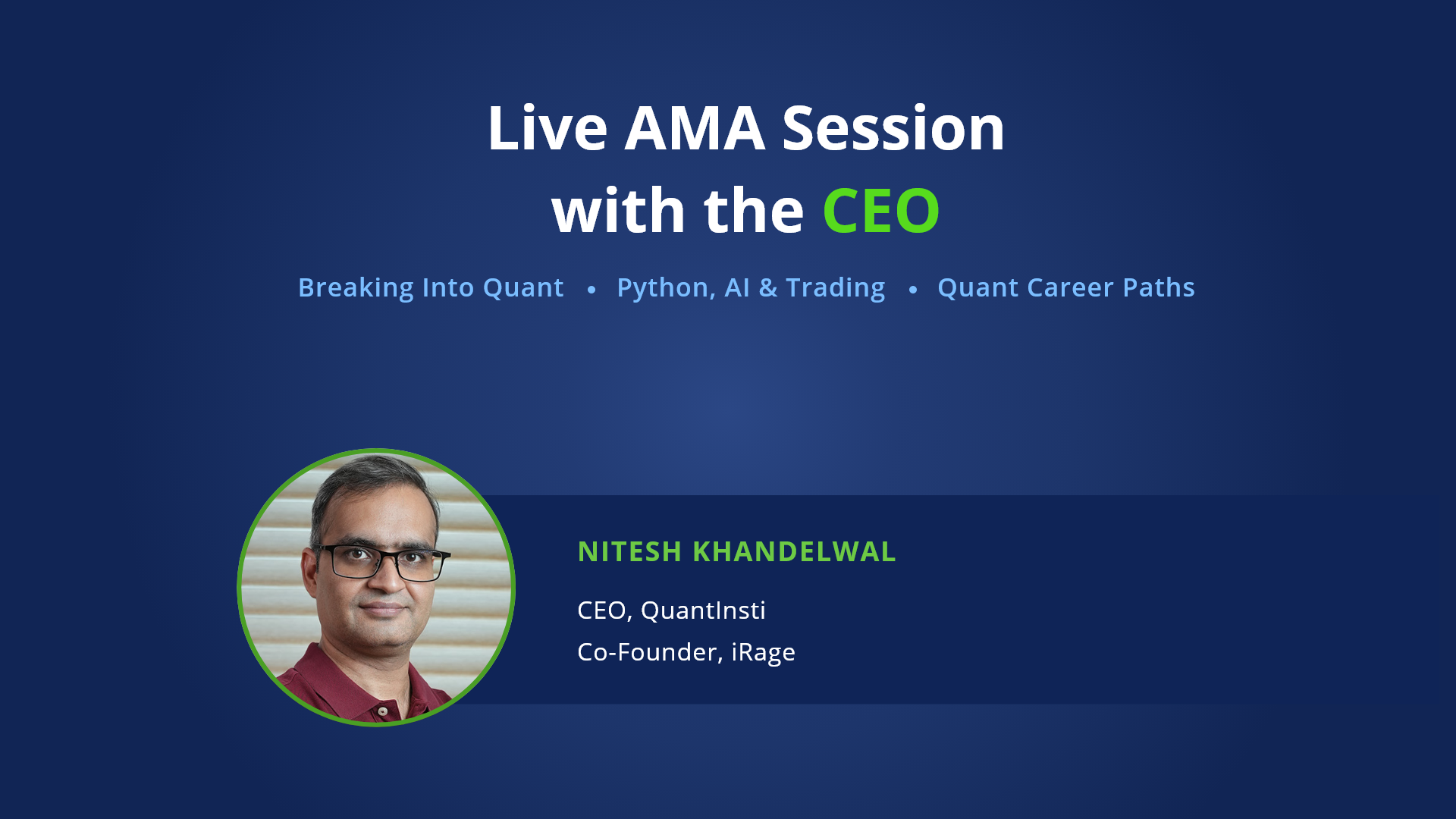
On July 9, 2026, QuantInsti hosted a live Ask Me Anything (AMA) with Nitesh Khandelwal, Co-Founder and CEO of QuantInsti and Co-Founder of iRage, one of Asia's most respected algorithmic and high-frequency trading firms. The session was an unfiltered, open Q&A on what it really takes to move from learner to practitioner in quantitative and algorithmic trading, spanning the domain, careers, the rise of AI and LLMs, and the role of the EPAT programme.
Hosted by Mohit Karwal, the session opened with a quick overview of EPAT and the state of the industry by Rohan Mathews (AVP, Global Business), before moving into a rapid-fire mix of pre-submitted and live audience questions answered directly by Nitesh. If you missed the live session, you can watch the full recording below.
What the Session Covered
The conversation moved across three broad areas, with the audience driving the depth. The first looked at structured learning: what learning quant and algo trading actually involves, how QuantInsti builds its programmes around real-world practitioners, and how a structured path differs from self-directed study.
The second focused on outcomes and careers: the paths available across geographies, what it takes to pivot in from finance, tech, or a discretionary trading background, and what separates the graduates who transition into quant research or institutional roles from those who do not.
The third turned to the domain itself: where to start from a non-coding or non-finance background, how Python, AI, and LLMs have reshaped what is possible for systematic traders, and what closes the gap between a learner and a practitioner.
The Speakers
Nitesh Khandelwal (Co-Founder and CEO, QuantInsti & Co-Founder, iRage) brings over two decades at the intersection of quantitative research, technology, and markets, having built both QuantInsti and iRage from the ground up. An alumnus of IIT Kanpur and IIM Lucknow, he has spoken at institutions including IIM Ahmedabad, NUS Business School, and IIT Delhi, and brings direct institutional experience into the EPAT curriculum.
Rohan Mathews (AVP, Global Business, QuantInsti) set the context with an overview of the quant and algo landscape heading into 2026 and how the EPAT ecosystem is built, from foundations through strategy paradigms, research, backtesting, and live deployment. Mohit Karwal hosted the session, curating pre-submitted questions and channelling live audience questions to the panel.
Key Takeaways from the AMA
A recurring theme ran through Nitesh's answers: in a world where LLMs make predictions cheap, the scarce and valuable input is human judgment. "It's not about the destination anymore," he noted of the modern algo trading journey. "It's more about the journey, and the process that you're following through the journey." Indicators, strategies, and tools, the things many beginners obsess over, are now a prompt away from any base-level model, so they no longer carry an edge.
His advice for anyone serious about trading as a career was to make it boring. As long as the thrill of watching profit and loss move up and down is the driver, he argued, trading stays a hobby. The money tends to flow once the focus shifts to the procedural and statistical work, and once a trader can answer a single hard question before going live: why is this strategy making money? "If you don't know the answer, then probably you don't have an edge. You have a curve fit."
On AI, Nitesh was direct about where it helps and where it does not. Coding, documentation, backtesting, research, and debugging are areas where models already do excellent work. Three things stay firmly on the human side: hypothesis formation, validating what is actually deployable, and risk. On careers, he stressed that there is no single best profile among quant researcher, developer, and trader; what matters is carving a path around genuine interest and building demonstrable proof of understanding. And Python, he confirmed, remains the lingua franca of the field, made more relevant, not less, by LLMs that generate it by default.
Frequently Asked Questions
How has the journey into algo trading changed over the last few years?
It has been constantly transitioning since iRage began in 2009, with each phase bringing new tools, infrastructure, and strategy styles. The biggest shift, from 2023 onwards, is the rise of LLMs. Predictions have become cheap while judgment has become scarce, so the game has moved away from the destination and towards a disciplined process.
A lot of people start with indicators, strategies, and tools. Where should they focus first?
None of those. Any base-level LLM will hand you a plethora of indicators, strategies, and tools, so they are not the alpha. What matters is the thought process you bring: what is the flow, and how do you form judgment? Judgment lives in deployment (testing edge cases, knowing exactly why a strategy makes money) and in risk assessment, which comes largely from experience.
For someone entering the field, what proof matters most: certificates, projects, GitHub, live trading, or conceptual clarity?
Ideally all of it, but if you must prioritise: conceptual clarity first, because without it there is nothing to build on, then something you can demonstrate. Discretionary live-trading experience is of limited value for quant and algo roles, where modelling and statistical exposure matter more. It tends to be a bit oversold.
What distinguishes the top graduates who transition into professional quant research or institutional roles?
Two things. First, making the most of the journey itself: the discipline of giving 45 to 55 minutes of uninterrupted attention regularly, over the six-to-nine-month programme, on top of weekend classes. Second, identifying the opportunities that overlap your background with where you want to be, then building both the skills and the demonstrable proof to show it.
What are common mistakes people make when transitioning into an algo trading career?
Not knowing what you actually want to build a career in. Many chase a profile because it sounds fancy or highly rewarding, but researchers, developers, and traders who are genuinely good all command a premium and have no ceiling on growth, because they enjoy the work. Ask whether you will actually enjoy the grunt work and the process.
Where can AI genuinely help, and what should not be outsourced to it?
AI is a great enabler for coding, documentation, backtesting, research, and debugging, with idea generation slightly less so. Three things cannot be left to AI: hypothesis formation, validating what is actually deployable, and the risk aspect. Your role is to hold a broad, correct understanding and to verify what the models produce.
How important is Python for someone serious about algorithmic trading?
Very important. Python remains the lingua franca of algo trading. For ultra-low-latency HFT, systems are typically built in C++ or on hardware such as FPGA and ASIC, but for medium and low-frequency work the interface can be almost anything, and Python is the most popular for research and for individual professionals. LLMs generate a lot of Python by default, so if you do not understand it, you will add very little value on top.
Starting from scratch in 2026 with basic coding and basic finance, what roadmap should you follow?
Coding skills are constructive, but understanding finance is now extremely important, because without it, knowing what you actually want stays unclear. Put more time into finance, and specifically market microstructure if you are aiming at quant trading. A good starting point is Trading and Exchanges by Larry Harris, along with the microstructure content and webinars on the QuantInsti portal.
What roles does the industry need most in 2026?
People who can leverage agents really well, meaning orchestration and agentic development rather than simply chatting with an agent. Combine that ability with a deep, rather than shallow, understanding of what you are doing, and you are in strong demand.
How is algo trading changing for retail and individual traders?
A significant democratisation is underway. You no longer need to buy high-end servers, since cloud and LLMs have lowered the barrier. Alpha generation from alternative data, such as annual reports and earnings calls through NLP, once needed institutional resources and is now possible with a free ChatGPT or Claude account. What has become harder, and more valuable, is the skill to validate those outputs and the judgment to decide which ideas to pursue.
Next Steps
If you are just getting started with algorithmic trading, begin with the Quantitative Trading Free Learning Track. It includes beginner-friendly courses covering data basics, trading strategies, and coding for finance.
For those looking for a comprehensive, guided journey with mentorship, live lectures, and career support, the Executive Programme in Algorithmic Trading (EPAT) provides a complete foundation for launching or accelerating a career in this field.
Schedule an EPAT counselling call. To understand if EPAT is the right choice for you, talk to one of our specialists who have counselled thousands of learners over the past decade and helped them make the right career decision.
Disclaimer: This webinar and recap are for educational and informational purposes only. Nothing discussed constitutes financial advice. Please conduct your own research and consult a qualified financial advisor before making any investment decisions.