Executive Programme in Algorithmic Trading - EPAT®
Become a Certified Algo Trader with Hands-On Training
Eager to launch your trading desk or advance your career in Algorithmic, Quantitative, and Automated Trading? EPAT course offers a comprehensive curriculum with top-tier faculty. Learn Python-based algo trading with hands-on experience using real-market data, leading APIs, and brokers. Get personalised support and certification while specialising in trading strategies through live project mentorship, setting the stage for a successful career as an algo trader.
What are EPAT Benefits?
Expert Faculty
An acclaimed team of subject matter experts
Dedicated Support
A Support Manager for each EPATian
Career Services
Lifetime placement and career assistance
EPAT features
Project work opportunity
Scholarships and Financial Aid
Lifetime access to latest course content
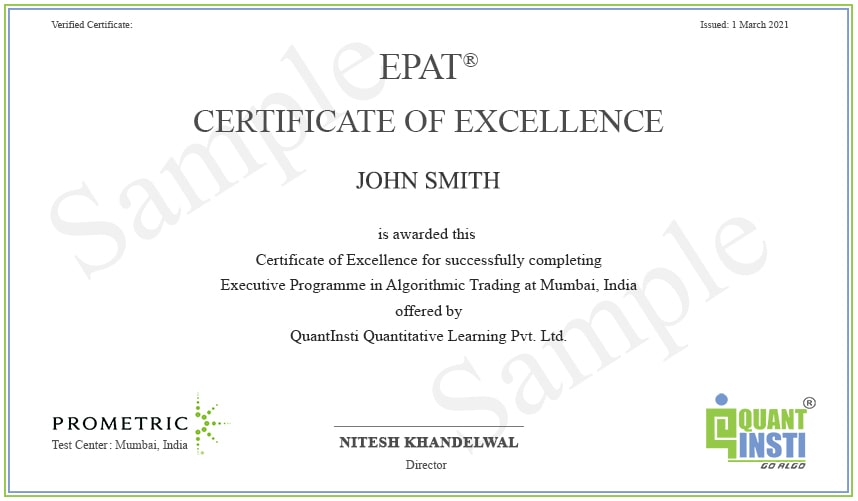
Verified Certification
Exclusive EPAT Community benefits
Credit Points for continuous professional development
120+
Hours Live Lectures
20+
World Class Faculty
300+
Placement Partners
90+
Participant Countries
EPAT Faculty

Dr. Robert Kissell
President, Kissell Research Group
Ex - UBS, JP Morgan

Brian Christopher
Founder and Researcher, Blackarbs LLC
Ex - Thomson Reuters

Dr. Thomas Starke
CEO, AAAQuants
Ex - VivCourt Trading, Rolls Royce

Dr. Yves J. Hilpisch
CEO, The Python Quants

Dr. Hui Liu
Founder & CEO, Creator, Running River Investment LLC & IBridgePy

Dr. Gaurav Raizada
Founder, iRage
Visiting Professor, IIM Ahmedabad

Rajib Ranjan Borah
Co-Founder & CEO, iRage
Visiting Faculty, IIM Ahmedabad, IIT Bombay
Ex - Optiver, PwC, Bloomberg

Anil Yadav
Systematic Trading Strategies, iRage
Ex - Lehman Brothers

Ashutosh Dave
Team Manager- Quantitative Research, Futures First
Ex - OSTC Ltd.

Ishan Shah
Lead, Research and Content, Quantra
Ex - Barclays, Bank of America Merrill Lynch

Jay Parmar
Quantitative Researcher, iRage
Ex - OSTC Ltd

Nitesh Khandelwal
Chief Executive Officer and Director, QuantInsti
Co-Founder, iRage
Ex - ICICI Bank

Nitin Aggarwal
Co-founder, Director, Alphom Advisory
Ex - Aditya Birla Group, BCG

Prodipta Ghosh
Vice President, QuantInsti
Ex - Deutsche Bank, Standard Chartered Bank, DRDO, Cognizant

Radha Krishna Pendyala
Data Scientist, Refinitiv

Varun Pothula
Quantitative Analyst, QuantInsti
Ex - Futures First, Accenture

Dr. Ankur Sinha
Professor, IIM Ahmedabad & Chairperson, 2-Year MBA (PGP)

Vivek Krishnamoorthy
Head - Placements | Head - Research, QuantInsti
Ex- ICICI Bank, Infosys

Manusha Rao
Quantitative Researcher, QuantInsti
Ex - Crisil, Cognizant
300+ PLACEMENT PARTNERS











Curriculum

Statistics & Econometrics
Quantitative Trading Techniques

Financial Computing
Python (key focus), Excel, MATLAB

Backtesting & Market Data
Equity, FX, Options, Futures, ETFs
1 EPAT Primer
- Stock market basics: Learning about financial markets and a brief understanding of how they work.
- Excel primer: Spreadsheet basics, learning to format and visualize data, using built -in functions to summarize and manipulate data, working with examples to familiarize yourself with spreadsheets.
- Python primer: Learning to work with Python in multiple ways (Spyder IDE, Jupyter Notebook), variables, data structures, functions, key libraries used
- Options primer: Learning terminology used, types of options, volatility and its types, and simple options trading strategies.
- Statistics primer: Introduction to descriptive statistics, probability theory, probability distributions, standard statistical distributions, inferential statistics, Introduction to linear regression.
- Macroeconomics primer: Introduction to key macroeconomic ideas like inflation, exchange rates, GDP, interest rates, fiscal and monetary tools.
- Machine learning for trading primer: Basic machine learning concepts, types of ML, and their application to trading, supervised and unsupervised ML algorithms with their implementation in financial markets.
- We will conduct two preparatory sessions to answer queries and resolve doubts on the statistics primer and the Python primer

2 Statistics for Financial Markets
- Key ideas in statistics and probability, and animating them with financial market data
- Creating and analyzing quant trading strategies on spreadsheets, creating charts to interpret their performance
- Learning portfolio construction and optimizing them using modern portfolio theory
- Introduction to Monte Carlo simulations and their applications on market data
- Studying the random walk model to predict future stock prices using simulations and assessing outcomes
- Understanding the capital asset pricing model
3 Python: Basics & Its Quant Ecosystem
- Data types, variables, Python in-built data structures, inbuilt functions, logical operators, and control structures
- Introduction to the main libraries in the data science stack: NumPy, pandas, and matplotlib
- Learning to write functions in Python
- Studying pandas routine used to analyze and visualize OHLCV data
- Writing and backtesting trading strategies
- Two Python tutorials will be conducted to answer queries and resolve doubts on the material covered in the lectures
4 Market Microstructure for Trading
- Overview of Electronic and Algorithmic Trading.
- Understanding market terminology, order book concepts and order types
- Introduction to execution strategies and handling market impact cost
- Understanding various algorithms such as Execution, Quant, and HFT
- Understanding different investment styles and trading algorithms
- Learning trading analytics
- Case studies
5 Equity, FX, & Futures Strategies
- Strategy building in equities - moving crossover, and VWAP
- Profit and loss analysis of a trading system
- Different types of Momentum (Time series & Cross-sectional)
- Trend following strategies and Statistical Arbitrage Trading strategy modeling with Python
- Arbitrage, market making and asset allocation strategies using ETFs
- Introduction to position sizing and risk management
6 Data Analysis & Modeling in Python
- Learning to backtest and analyze various strategies on Python using historical data
- Understanding object-oriented programming (OOP) concepts and using OOP to backtest trading strategies
- Glimpse of the basic cloud infrastructure to host automated Python strategies
- Learning vectorized and event-driven backtesting along with trade parameter optimization
- Learning the work flow of a quant strategy
- Two tutorials will be conducted to answer queries and resolve doubts related to the material covered in the related lectures
7 Machine Learning for Trading
- Classical ML algorithms: Support Vector Machines (SVM), k-means clustering, logistic regression, decision trees, random forests
- Introduction to deep learning: Neural networks, gradient descent, and backpropagation algorithms
- Using Python to build and evaluate ML models for potential trading strategies (by creating features and selecting suitable ones)
- Learning principal component analysis (PCA) and using it to create statistical arbitrage strategies in multiple co-integrated assets
- Learning about alternate data: sources, data formats, storage and retrieval
- Introduction to deep reinforcement learning and implementing RL in a simple strategy using 'gamification'
- Learn how to backtest a strategy using machine learning
8 Trading Tech, Infra & Operations
- Learning the different trading paradigms - LFT, MFT, and HFT
- Understanding the system architecture of a traditional trading system
- Understanding the system architecture of an automated trading system
- Assessing the challenges in building a trading system
- Learning about the infrastructure (hardware, software, network, etc.) requirements to start an algo trading desk
- Understanding the business environment (including regulatory, financials, etc.) to start an algo trading desk
- Overview on business requirements to start an algo trading desk
- Examples of starting out in developing markets and developed markets
9 Advanced Statistics for Quant Strategies
- Learning time series-centric terminology like stationarity, ACF, PACF
- Learning common features of financial asset returns
- Introduction to the ARIMA family of models
- Learning to model volatility
- Introduction to ARCH and GARCH models
- Building and testing trading strategies using time series modeling techniques on Python
10 Trading & Back-testing Platforms
- Introduction to the Interactive Brokers (IB) platform and Blueshift
- Working with IB Trader WorkStation (TWS) and the IB TWS API architecture
- Learning the REST API (used by hundreds of brokers worldwide) and its components
- Exposure to multiple Python solutions for algo trading
- Learning to use IBridgePy (API used to backtest and live trade strategies with brokers like Interactive Brokers, Robinhood, TD Ameritrade)
- Managing multiple accounts as a fund manager
11 Portfolio Optimization & Risk Management
- Learning about different methods to evaluate portfolio and strategy performance
- Understanding risk management: sources of risk, risk limits, risk evaluation and mitigation, risk control systems
- Backtesting of portfolio management and risk analysis in Python using the Modern Portfolio Theory and Monte Carlo simulations
- Profitability analysis of individual strategies
- Building a portfolio with multiple stocks
- Profitability analysis of a portfolio
12 Options Trading & Strategies
- Introduction to options, payoff diagrams, common option structures
- General option trading principles, model-independent option features
- Option pricing variables and parameters
- Option pricing concepts (Black-Scholes-Merton)
- Options Greeks
- Options trading (early exercise and expiration trading)
- Risk management and trade evaluation
- Volatility premium
- Volatility trading with options, realized and implied volatility
- Hedging in practice
- Building an Options Backtesting model
13 Hands-on Project
- Self-study project work under the mentorship of a domain expert
- Project topic can come from different areas of financial market trading (be it asset class, techniques used, market selected) and can help crystallize your learnings from the EPAT into something concrete
14 EPAT Exam
- EPAT exam is conducted at proctored centers in 80+ countries
NEW Agentic AI For Trading
This lecture series demonstrates how generative AI, including large language models and agent-based systems, is used in trading and research. It focuses on implementation with illustrations showing how these tools fit into real workflows.
Lecture 1: Large Language Models in Trading
- Mental model of how LLMs work, including transformers and attention.
- Grounded understanding of where LLMs create value in trading workflows, using the FinBERT model.
- Framework for using LLMs in research tasks such as news analysis, earnings call parsing, and research summarization.
- How to design prompts for finance use cases that reduce noise and hallucinations.
- Awareness of model risk, latency, and production constraints in trading environments.
Lecture 2: Quantitative trading using AI agents
- What agentic AI is and why single LLM calls are usually not enough for trading workflows.
- A blueprint to build a multi-agent quant research pipeline using make.com.
- Orchestrating financial research tasks.
- Challenges in production systems.
- Framework to evaluate how to deploy agentic systems in your setup.
Certificate

EPAT is accredited by CPD, UK (Continuing Professional Development, UK)

QuantInsti has registered this program with GARP for Continuing Professional Development (CPD) credits. Attending this program qualifies for 30 GARP CPD credit hours. If you are a Certified Financial Risk Manager (FRM®), or Energy Risk Professional (ERP®), please record this activity in your Credit Tracker.


Learner Reviews
We have a 4.8 rating out of 400+ Google reviews
Marcus Coleman
United States 

QuantInsti is the best place to learn professional algorithmic and quantitative trading. The EPAT program is a highly structured and hands-on learning experience, and it's being updated frequently.The facu… See More
QuantInsti is the best place to learn professional algorithmic and quantitative trading. The EPAT program is a highly structured and hands-on learning experience, and it's being updated frequently.The faculty and staff are extremely competent and available to address any concerns you may have.Upon completion of the EPAT program, you will have the necessary tools to begin a career in algorithmic/ quantitative trading.
Wei Jie
United States
I find this program great. Before taking this program, I had not any experience in Quant-trading. I studied mathematics at university and worked as a private banker in China. I am very interested in Quant-… See More
I find this program great. Before taking this program, I had not any experience in Quant-trading. I studied mathematics at university and worked as a private banker in China. I am very interested in Quant-trading. So I took this program. And now, I can write a simple pair-trading strategy, use Monte Carlo simulation to predict, and gained the necessary AI knowledge for further self-learning. This program is very useful for me. And the learning assistant is great too. He communicated with me every two weeks and always answered my queries very soon.
Jad Mawlawi
United Kingdom
EPAT has been a great experience for me. It is definitely the best program out there to learn quantitative finance and algorithmic trading. The team was, and still is, very helpful and caring. The course i… See More
EPAT has been a great experience for me. It is definitely the best program out there to learn quantitative finance and algorithmic trading. The team was, and still is, very helpful and caring. The course itself is a combination of different disciplines, including programming, finance, and statistics, taught by a very knowledgeable and experienced faculty.
Billy Davila
United States
I recently completed the EPAT program from QuantInsti, and it was a rich experience. I learned more here than I did in my university curriculum. This is mainly because the EPAT course is very practical, an… See More
I recently completed the EPAT program from QuantInsti, and it was a rich experience. I learned more here than I did in my university curriculum. This is mainly because the EPAT course is very practical, and I was able to learn a lot in such a short time. It provided me with a lot of theoretical and practical knowledge in the algorithmic trading domain. Besides their excellent curriculum, the support team is friendly, dedicated, and always there to support you during your EPAT journey. They also have a placement team that keeps you updated with career opportunities. However, keep in mind that your background will influence how well you fit into those career opportunities. They also have a self-paced learning portal named Quantra, which I really enjoy. Overall, they are excellent at what they do.
Venka Challa
United States
EPAT is a great course for anyone who likes to learn algo-trading. The course work is quite comprehensive. Though I have years of experience in discretionary trading, taking EPAT got me introduced to this … See More
EPAT is a great course for anyone who likes to learn algo-trading. The course work is quite comprehensive. Though I have years of experience in discretionary trading, taking EPAT got me introduced to this phenomenal area. And I am happy I did it. Starting with Excel, which is used by almost all institutional traders and retail traders alike, the courses teach you the most relevant Python language constructs.For me, this was quite helpful because I am not a developer and didn't know where to start with programming languages for Trading. The course takes you through the most basic ideas using Excel and Python to complex trading arenas such as Options trading.ML courses were quite helpful as well since EPAT courses guide you through the usage of ML in Trading. One of the best features of EPAT course structure is that they bring industry experts to teach you real- world scenarios.Some of these traders are world - renowned, in fact(at least in the Trading arena).Overall, I do not hesitate to recommend EPAT to anyone who likes to learn algo - trading!
Srikhanth Hanumanthapaa
United States
Quant Insti helped improve my Quant skills and trading strategies to execute in Python.I was learning the EPAT course from the USA and highly recommend this course to all aspiring Algo Traders and Quant De… See More
Quant Insti helped improve my Quant skills and trading strategies to execute in Python.I was learning the EPAT course from the USA and highly recommend this course to all aspiring Algo Traders and Quant Developers.Great teaching faculty, and Siddu was great at mentoring me and helping with the course.I recommend EPAT and Quantra classes from QuantInsti.A great platform to learn and excel.Worldwide job placements are excellent after the course.
Jonathon Stanton
United States
This is a fantastic course; it's hard work, but you'll get a lot out of it. The support team is definitely one hundred percent there to help anybody achieve their goals. Despite this, algorithmic trading i… See More
This is a fantastic course; it's hard work, but you'll get a lot out of it. The support team is definitely one hundred percent there to help anybody achieve their goals. Despite this, algorithmic trading is not an easy profession.
Simon Lafrenière
Canada
I would highly recommend taking the EPAT program to anyone interested in becoming a successful algorithmic trader. The course material is excellent; the teachers are experienced and expose the learnings in… See More
I would highly recommend taking the EPAT program to anyone interested in becoming a successful algorithmic trader. The course material is excellent; the teachers are experienced and expose the learnings in a clear and assimilable manner. You develop both a general understanding and dive deep into the specifics to develop all the skills required to succeed. They do their best to answer our questions, and the recordings allow us to learn at our own pace. All the staff members are very nice and supportive. They make sure we receive the best value from our investment in this high-quality education with them. The alumni network is very active and passionate about growing as a community. This is rare in my experience with online learning. Thank you to everyone at Quantinsti for making our experience so positive!
Pratik Mangwani
United States
EPAT is one of the best investments one can make to get started in the quant industry. Esteemed faculty, with real-life use cases of all teachings, make the course highly valuable with the skills taught. G… See More
EPAT is one of the best investments one can make to get started in the quant industry. Esteemed faculty, with real-life use cases of all teachings, make the course highly valuable with the skills taught. Great alumni services and community, coupled with fantastic support from the staff.
Alvin Sims
United States
Great program. They stay with you after the courses are finished. A true trading family!
Great program. They stay with you after the courses are finished. A true trading family!
Lusine Baghdasaryan
United States
I have recently become an EPATIAN and would love to share how delighted I am with the EPAT program. IT IS A COMPREHENSIVE, practical, hands-on, and at the same time, theoretical program. It gives you good … See More
I have recently become an EPATIAN and would love to share how delighted I am with the EPAT program. IT IS A COMPREHENSIVE, practical, hands-on, and at the same time, theoretical program. It gives you good knowledge of the financial markets and backtesting opportunities with several software packages. The program is taught by professionals, traders with PhDs, professors of renowned universities, and founders of hedge funds. The staff is helpful and very nice; they have supported me at high levels with every single request I have made! It’s a great program, and I strongly recommend it to anyone interested in entering financial markets!
Eriz Zárate
Spain
Only great words to say about QuantInsti and my learning path during the EPAT program. Always curious, always listening, and always improving. All the staff, from the CEO down to the support personnel, we… See More
Only great words to say about QuantInsti and my learning path during the EPAT program. Always curious, always listening, and always improving. All the staff, from the CEO down to the support personnel, were very nice 120% of the time (the 20% excess goes to all the help that they have given me after concluding the course, every time with a consistent will to help others). Regarding the EPAT program content, the key thing I would like to say is that it is a wide-covering approach. During six months, industry experts (i.e., real practitioners, not Gurus) dive into a variety of topics from scratch so that, after that, you can choose in which field you are going to focus on. My final thoughts for new EPATians are: it is a must-do course if you are beginning in the field of algorithmic trading and quantitative finance. Although the real value is in the people that drive the institution. Be sure that you will have to take more courses after EPAT to succeed in this field, but you won't find the lifelong learning support that they will give you anywhere else.
Marco Veterani
Spain
The EPAT program has really been a good experience for me: I've learned a lot about how financial markets work, how to code strategies in EXCEL, Python and R, got introduced to advanced statistical concept… See More
The EPAT program has really been a good experience for me: I've learned a lot about how financial markets work, how to code strategies in EXCEL, Python and R, got introduced to advanced statistical concepts like ARIMA and GARCH and how to apply Machine Learning algorithms into trading systems. The support team has been great in assisting my learning experience. It's also an excellent way to connect with other students and with the lecturers (that are all carefully selected and highly professional). Highly recommended!
Nicolò Pirozzi
Italy
The course is very organized, both theoretically and practically, the staff is very competent and helpful. I found myself at ease during the whole course of study. I learned the basics to start a career in… See More
The course is very organized, both theoretically and practically, the staff is very competent and helpful. I found myself at ease during the whole course of study. I learned the basics to start a career in algorithmic trading and finance in general. What I appreciated the most were the lessons held with prominent personalities from the world of finance and trading, who shared their knowledge and experiences with the students. I would definitely recommend the course to anyone wishing to pursue a career in trading and finance.
Mauricio Loaiza
Brazil
EPAT is a well-structured program if you want to learn algorithmic trading; it includes a vast amount of assets analysis and trading strategies, all of them studied in depth. There are many opportunities t… See More
EPAT is a well-structured program if you want to learn algorithmic trading; it includes a vast amount of assets analysis and trading strategies, all of them studied in depth. There are many opportunities to practice on our own, and there are many opportunities to learn from the lecturers and the other participants. The lecturers include some of the most recognized people in their respective field. The faculty and the support team were always available to help or to answer our questions. It was a very good experience.
Maximiliano Tomasello
Germany
Very professional and knowledgeable team and learning platform. I was part of the EPAT program during 2022, and I can say that I only saw my understanding of algorithmic trading grow. The support team is a… See More
Very professional and knowledgeable team and learning platform. I was part of the EPAT program during 2022, and I can say that I only saw my understanding of algorithmic trading grow. The support team is also great. I will definitely do another course with QuantInsti soon.
Manish Sharma
Australia
The quality of EPAT program is outstanding. The content delivered is priceless and very hard to find anywhere else.
The quality of EPAT program is outstanding. The content delivered is priceless and very hard to find anywhere else.
Majdi Shawar
Israel
EPAT is an excellent comprehensive algorithmic trading course. Excellent Faculty. I would highly recommend it to people who wish to pursue a career in the algorithmic trading domain.
EPAT is an excellent comprehensive algorithmic trading course. Excellent Faculty. I would highly recommend it to people who wish to pursue a career in the algorithmic trading domain.
ADMISSION PROCESS
Send your
Application
Get on a call
with a Counsellor
Application
acceptance
Pay the fee
and get started
Send your
Application
Get on a call
with a Counsellor
Application
acceptance
Pay the fee
and get started
Before admission, we will facilitate a one-on-one counselling session that will focus on understanding the strengths and weaknesses of the participant. These sessions do not necessarily decide the participants' eligibility but help counsellors assist them with informed guidance prior to enrollment.
Batches & Fee Structure
Super Early Bird Discount
Early Bird Discount
Standard Fees
Start Date
11th Jul 2026
Super Early Bird Enrollment Fees
6,999 (valid till 30th Apr 2026)
Early Enrollment Fees
8,599 (valid till 5th Jun 2026)
Standard Enrollment Fees
9,499 (valid till 5th Jul 2026)
Start Date
10th Oct 2026
Super Early Bird Enrollment Fees
7,799 (valid till 31st Jul 2026)
Early Enrollment Fees
8,599 (valid till 7th Sep 2026)
Standard Enrollment Fees
9,499 (valid till 6th Oct 2026)
Start Date
9th Jan 2027
Super Early Bird Enrollment Fees
7,799 (valid till 30th Oct 2026)
Early Enrollment Fees
8,599 (valid till 4th Dec 2026)
Standard Enrollment Fees
9,499 (valid till 6th Jan 2027)
Start Learning Now!
Batch 72
792/mo*
for 12 mo. at 0% APR